
 By admin
Artificial Intelligence: From Conceptual Origins to Global Dominance – A Comprehensive Exploration of Its History, Applications, and Economic Power
Introduction
Artificial Intelligence (AI) has emerged as one of the most influential and transformative forces of the modern age. What once existed solely as a speculative idea in philosophical debates and science fiction narratives has evolved into a sophisticated technological reality shaping economies, industries, and daily life. In the 21st century, AI is no longer a futuristic promise—it is a present-day engine of innovation, productivity, and wealth creation.
From personalized digital assistants and autonomous vehicles to medical diagnostics and financial forecasting, AI systems are redefining how humans interact with technology and make decisions. More importantly, AI has become a central pillar of the Fourth Industrial Revolution, driving unprecedented economic growth and altering the global balance of power. Governments, corporations, and individuals alike now recognize AI as a strategic asset capable of generating immense competitive advantages.
This comprehensive article explores Artificial Intelligence from its historical foundations to its modern dominance. It examines the evolution of AI technologies, their transformative applications across industries, their ethical and geopolitical implications, and their growing role as the most powerful engine of wealth in the global economy. Understanding AI is no longer optional—it is essential for navigating the future.
I. The Origins and Evolution of Artificial Intelligence
1. Early Philosophical Foundations and Conceptual Beginnings
The desire to create intelligent machines predates modern computing by centuries. Ancient myths, philosophical inquiries, and mechanical inventions all reflect humanity’s fascination with artificial beings capable of reasoning and autonomy. However, AI as a scientific discipline began to take shape in the mid-20th century, alongside the development of digital computers.
One of the most influential early thinkers was Alan Turing, whose 1950 paper “Computing Machinery and Intelligence” posed the groundbreaking question: “Can machines think?” Turing proposed what later became known as the Turing Test, a benchmark for evaluating a machine’s ability to exhibit intelligent behavior indistinguishable from that of a human.
2. The Birth of AI as a Scientific Field
The official birth of Artificial Intelligence occurred in 1956 during the Dartmouth Summer Research Project on Artificial Intelligence, organized by John McCarthy, Marvin Minsky, Nathaniel Rochester, and Claude Shannon. John McCarthy coined the term “Artificial Intelligence,” expressing optimism that every aspect of learning and intelligence could, in principle, be described and simulated by a machine.
Early AI programs such as the Logic Theorist and General Problem Solver demonstrated machines’ ability to solve mathematical problems and apply logical reasoning. These successes generated enormous enthusiasm and attracted significant funding from governments and research institutions.
3. AI Winters and Technological Limitations
Despite early optimism, progress proved slower and more complex than anticipated. Real-world intelligence required contextual understanding, perception, and common sense—capabilities that exceeded the computational power and data availability of the time. As expectations clashed with reality, funding declined during periods known as AI winters in the 1970s and late 1980s.
These setbacks, however, were not failures. They prompted researchers to refine algorithms, explore probabilistic models, and develop new approaches that would later fuel AI’s resurgence.
4. The Modern AI Renaissance
The 21st century marked a dramatic revival of Artificial Intelligence, driven by three converging forces:
- The explosion of big data generated by the internet and digital devices
- Exponential growth in computational power, particularly GPUs and cloud computing
- Advances in algorithms, especially deep learning and neural networks
This convergence enabled AI systems to learn from vast datasets, recognize patterns with extraordinary accuracy, and perform complex tasks once thought impossible for machines.
II. Core Technologies Powering Artificial Intelligence
1. Machine Learning: The Engine of Adaptation
Machine Learning (ML) is a subset of AI that allows systems to learn from data and improve performance without explicit programming. Instead of following rigid rules, ML models identify patterns and make predictions based on experience.
Key types of machine learning include:
- Supervised learning, where models learn from labeled data
- Unsupervised learning, which identifies hidden structures in unlabeled data
- Reinforcement learning, where agents learn through trial and error
2. Deep Learning and Neural Networks
Deep learning represents a breakthrough in machine learning. Inspired by the structure of the human brain, deep neural networks consist of multiple layers that process information hierarchically. This approach excels at handling unstructured data such as images, speech, and text.
Deep learning has enabled major advances in:
- Computer vision
- Speech recognition
- Natural language understanding
- Autonomous decision-making
3. Natural Language Processing and Generative AI
Natural Language Processing (NLP) allows machines to understand, interpret, and generate human language. Recent innovations in large language models (LLMs) have revolutionized communication, content creation, and customer interaction.
Generative AI systems can now:
- Write articles and reports
- Generate software code
- Translate languages in real time
- Create original art, music, and video
These capabilities mark a shift from AI as an analytical tool to AI as a creative collaborator.
III. Transformative Applications Across Key Industries
1. Healthcare and Life Sciences
AI is revolutionizing healthcare by improving accuracy, efficiency, and personalization. Machine learning algorithms analyze medical images, detect diseases at early stages, and support clinical decision-making. In drug discovery, AI accelerates the identification of new compounds, reducing costs and development time.
Breakthroughs such as protein structure prediction have opened new frontiers in biotechnology and personalized medicine.
2. Finance, Banking, and Fintech
In the financial sector, AI enhances risk assessment, fraud detection, and investment strategies. Algorithmic trading systems analyze market data in real time, while AI-driven credit scoring expands financial inclusion.
Chatbots and robo-advisors improve customer service and wealth management, making financial tools more accessible than ever before.
3. Transportation and Autonomous Systems
AI plays a central role in autonomous vehicles, combining computer vision, sensor fusion, and real-time decision-making. Beyond self-driving cars, AI optimizes logistics, traffic management, and supply chains, reducing costs and environmental impact.
4. Manufacturing and Industry 4.0
In smart factories, AI enables predictive maintenance, quality control, and robotic automation. These systems increase productivity, reduce downtime, and enhance worker safety, forming the backbone of Industry 4.0.
5. Creative and Media Industries
AI-powered tools are transforming creative work. Designers, writers, musicians, and filmmakers use generative AI to enhance productivity and explore new forms of expression. Rather than replacing creativity, AI amplifies human imagination.
IV. Artificial Intelligence and Global Dominance
1. Superhuman Performance in Narrow Domains
AI systems now outperform humans in specialized tasks, from medical image analysis to strategic games. This narrow AI dominance underpins its economic value and widespread adoption.
2. Geopolitical Competition and National Strategy
AI has become a strategic priority for nations worldwide. Governments view AI leadership as essential for economic growth, technological sovereignty, and national security. Massive investments in AI research, talent, and infrastructure reflect its geopolitical importance.
3. Ethical, Legal, and Social Challenges
With great power comes great responsibility. AI raises critical concerns regarding data privacy, algorithmic bias, job displacement, and accountability. Developing ethical frameworks and regulatory standards is essential to ensure that AI benefits society as a whole.
V. Artificial Intelligence as the Ultimate Source of Wealth
1. Economic Growth and Productivity Revolution
AI is reshaping the global economy by automating cognitive tasks and enhancing decision-making. It acts as a productivity multiplier, enabling businesses to scale operations and innovate faster than ever before.
Entirely new markets—such as generative AI platforms and data-driven services—are emerging, contributing trillions of dollars to global GDP.
2. Data as the New Oil
In the AI-driven economy, data is the most valuable resource. Organizations that collect, manage, and analyze high-quality data gain a decisive advantage in training superior AI models and generating insights.
3. Business Strategies for AI-Driven Wealth Creation
Key strategies include: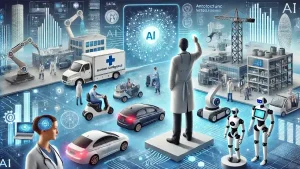
- Developing proprietary AI models and intellectual property
- Monetizing data responsibly and ethically
- Delivering hyper-personalized products and services
- Optimizing operations through predictive analytics
- Leveraging cloud-based AI tools to reduce entry barriers
4. The Future of Work and Human–AI Collaboration
Rather than replacing humans, AI is redefining work. The most successful professionals will be those who collaborate with AI systems—combining human judgment with machine intelligence. AI literacy is rapidly becoming a core economic skill.
Conclusion
Artificial Intelligence has journeyed from abstract theory to global dominance in just a few decades. It has transformed industries, reshaped economies, and redefined the boundaries of human capability. As the driving force of the Fourth Industrial Revolution, AI stands not only as a technological achievement but as the most powerful engine of wealth creation in modern history.
The challenge ahead lies not in whether AI will shape the future—it already is—but in how humanity chooses to guide its development. Ethical governance, inclusive innovation, and strategic investment will determine whether AI becomes a force for shared prosperity or deepened inequality. Ultimately, the future of Artificial Intelligence is inseparable from the future of humanity itself.
Future-Proofing Your IT Career