
 By admin
All About CMAs: Certified Management Accountants and Their Career Pathways
Introduction
The world of accounting and finance offers a wide range of career opportunities, but two of the most recognized designations are Certified Public Accountant (CPA) and Certified Management Accountant (CMA). While CPAs typically focus on public accounting, auditing, and tax services, CMAs specialize in management accounting, financial strategy, and decision support within organizations. This distinction makes CMAs highly valuable for corporations, government agencies, and nonprofit organizations seeking professionals who can interpret financial data and provide strategic insights.
In today’s competitive job market, understanding the role, responsibilities, certification process, and career potential of CMAs is essential for anyone considering a career in finance or accounting. This article explores everything you need to know about CMAs, including their job functions, salaries, certification process, comparison with CPAs, and the future outlook of this profession.
What Is a CMA?
A Certified Management Accountant (CMA) is a professional credential awarded to individuals who demonstrate expertise in financial planning, performance management, cost management, internal controls, and decision support. Unlike CPAs, who often serve external clients, CMAs primarily work internally within organizations, supporting executives and managers in making informed strategic decisions.
Key Responsibilities of a CMA
- Preparing and analyzing financial statements
- Budgeting and forecasting
- Cost management and reduction strategies
- Internal auditing and compliance
- Evaluating investment opportunities
- Supporting business strategy and performance improvement
Where Do CMAs Work?
CMAs are versatile professionals and can be employed in a variety of settings:
- Corporate Firms: Assisting executives with budgeting, cost control, and long-term financial planning.
- Government Agencies: Overseeing public funds, auditing government programs, and ensuring regulatory compliance.
- Nonprofit Organizations: Managing budgets, grants, and donor funds with transparency and accountability.
Popular Job Titles for CMAs
- Bookkeeper – Entry-level financial recordkeeping (does not require CMA certification but often leads to more advanced roles).
- Payroll Clerk – Focused on payroll processing; requires Certified Payroll Professional (CPP) but not CMA.
- General Accountant – Prepares reports, maintains ledgers, and ensures financial accuracy (many CMAs start here).
- Budget Analyst – Evaluates spending, forecasts future budgets, and improves efficiency.
- Cost Accountant – A core CMA role, specializing in tracking and managing organizational costs.
- Internal Auditor – Ensures internal controls, risk management, and compliance (often requires additional CIA certification).
- IT Auditor – Reviews financial systems, security, and compliance (requires CISA certification in addition to CMA).
CMA Salaries and Career Growth
One of the most attractive aspects of becoming a CMA is the competitive salary range.
- Entry-level roles: Salaries often start at $50,000 annually, significantly higher than many general accounting positions.
- Mid-level professionals: CMAs with 5–10 years of experience often earn between $75,000–$100,000.

- Senior and executive roles: Experienced CMAs in leadership positions can earn $120,000–$150,000 or more annually, depending on industry and location.
CMA vs CPA Salary Comparison
While CPAs earn competitive salaries, CMA-certified professionals often report higher earnings globally, particularly in management and executive roles. According to the Institute of Management Accountants (IMA) 2024 salary survey, CMAs earn on average 58% more in median total compensation than their non-certified peers.
How to Become a CMA
The CMA certification is offered by the Institute of Management Accountants (IMA) and is globally recognized. It demonstrates not only accounting expertise but also business acumen, leadership, and strategic financial management skills.
Requirements for CMA Certification
- Education – A bachelor’s degree from an accredited institution (in accounting, finance, or related fields).
- Work Experience – At least two years of continuous professional experience in management accounting or financial management.
- CMA Exam – Candidates must pass a rigorous two-part exam covering:
- Financial Planning, Performance, and Analytics
- Strategic Financial Management
- Membership – Active membership in the IMA.
Exam Difficulty and Preparation
The CMA exam is considered challenging, with pass rates averaging 45–50% globally. Candidates typically spend 150–200 hours per part studying. Popular preparation strategies include online CMA review courses, practice exams, and study groups.
CMA vs CPA: Which One Should You Choose?
While both CMAs and CPAs are highly respected, the career focus differs significantly.
Key Differences
-
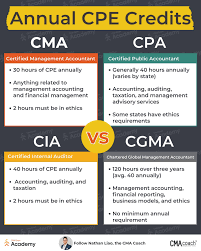
CMA: Specializes in internal financial management, strategy, and decision-making within an organization.
- CPA: Focuses on public accounting, auditing, and taxation for multiple clients.
Work Variety
- CMA: Work tends to be more routine, focusing on internal processes.
- CPA: Greater variety of work depending on client needs, industries, and audit requirements.
Career Outlook
- Aspiring professionals seeking a career in corporate finance, management, and business strategy will find CMA more valuable.
- Those interested in taxation, auditing, and public accounting services may benefit more from CPA licensing.
Roles of a CMA in Business Decision-Making
One of the primary advantages of hiring a CMA is their ability to provide strategic insights. Unlike traditional accountants, CMAs are trained to interpret financial data to support business growth.
Contributions to Business Success
- Financial Decision Support – Helping executives decide on investments, expansions, and cost control.
- Risk Management – Identifying and mitigating financial risks within the organization.
- Performance Measurement – Tracking key performance indicators (KPIs) and suggesting improvements.
- Cost Optimization – Ensuring efficient use of resources to maximize profitability.
Future of CMAs in the Global Market
The demand for CMAs is expected to grow significantly in the coming years due to globalization, technological advancement, and the increasing complexity of financial management.
Key Trends Shaping the CMA Profession
- Digital Transformation – CMAs with skills in data analytics, AI, and financial technology (FinTech) will be in high demand.
- Global Recognition – The CMA credential is gaining more value worldwide, especially in emerging markets.
- Sustainability Accounting – Organizations need CMAs to integrate environmental, social, and governance (ESG) reporting into financial analysis.
- Hybrid Roles – CMAs are increasingly combining finance expertise with IT, risk management, and strategic consulting.
Why Businesses Should Hire a CMA
For businesses, particularly startups and growing enterprises, hiring a CMA can provide long-term cost savings and operational efficiency.
Benefits of Hiring a CMA In-House
- Reduced reliance on expensive CPA services
- Consistent internal financial monitoring
- Better budgeting and forecasting accuracy
- Stronger internal controls and compliance
- Strategic financial guidance for business growth
Conclusion
The role of a Certified Management Accountant (CMA) extends far beyond traditional bookkeeping and accounting. CMAs are strategic business partners who bring valuable insights into cost management, budgeting, decision-making, and long-term financial planning. While the certification process is demanding, the career rewards—higher salaries, global recognition, and leadership opportunities—make it a highly worthwhile investment.
For individuals passionate about finance, strategy, and business growth, becoming a CMA is one of the most effective ways to build a successful and fulfilling career. Likewise, for organizations seeking a financial professional who goes beyond number-crunching to provide strategic vision, a CMA is the perfect fit.
Why Donating to Charities Matters