
 By admin
What Is Accounting? Understanding the Language of Business in the Modern Economy
Introduction
In today’s data-driven and highly competitive business environment, accounting is far more than a routine administrative function. It is the foundation upon which organizations make informed financial decisions, evaluate performance, manage risks, and achieve sustainable growth. Whether it is a multinational corporation, a small startup, a nonprofit organization, or an individual managing personal finances, accounting plays a critical role in ensuring financial stability and transparency.
Many people associate accounting with paying bills, preparing tax returns, or balancing ledgers. While these tasks are important, modern accounting extends far beyond basic bookkeeping. It provides valuable insights into profitability, operational efficiency, cash flow management, and strategic planning. Without accurate accounting, businesses would struggle to understand their financial position, comply with regulations, attract investors, or plan for the future.
This article explores the true meaning of accounting, its importance in everyday life and business, the different branches of accounting, modern accounting technologies, and why accounting remains one of the most essential functions in the global economy.
What Is Accounting?
Accounting is the systematic process of recording, organizing, analyzing, interpreting, and reporting financial transactions. It serves as the financial language of business, enabling organizations and individuals to track income, expenses, assets, liabilities, and overall financial performance.
At its core, accounting transforms financial data into meaningful information that can be used to make informed decisions. Every financial transaction—whether purchasing inventory, paying salaries, receiving customer payments, or investing in equipment—is recorded and analyzed through accounting systems.
The primary purpose of accounting is to provide accurate and reliable financial information to stakeholders, including:
- Business owners
- Managers
- Investors
- Creditors
- Government agencies
- Employees
- Customers
Without accounting, it would be impossible to measure financial success or identify potential financial problems.
The Historical Evolution of Accounting
Accounting has existed for thousands of years. Ancient civilizations such as the Egyptians, Greeks, and Romans maintained records of trade, taxes, and government expenditures.
One of the most significant developments in accounting occurred during the Renaissance when the double-entry bookkeeping system was formalized by the Italian mathematician and friar Luca Pacioli, often referred to as the “Father of Accounting.”
Since then, accounting has evolved dramatically. Today, advanced accounting software, cloud computing, artificial intelligence, and automation have transformed the profession into a sophisticated financial management discipline capable of handling vast amounts of data in real time.
Why Accounting Matters in Everyday Life
Many people assume accounting is only relevant to businesses, but accounting principles affect everyone.
Personal Financial Management
Individuals use accounting concepts every day when they:
- Create budgets
- Track expenses
- Manage bank accounts

- Save money
- Pay debts
- Invest for retirement
Every financial decision involves basic accounting principles.
For example, a family preparing a monthly budget must compare income against expenses to determine whether they are operating at a surplus or deficit. This process is essentially a form of personal accounting.
Financial Awareness and Planning
Accounting helps individuals:
Monitor Spending Habits
Tracking expenses provides insight into spending patterns and helps identify unnecessary expenditures.
Achieve Financial Goals
Whether saving for a home, education, or retirement, accounting helps individuals create realistic financial plans.
Avoid Debt Problems
Proper financial tracking reduces the risk of overspending and accumulating unmanageable debt.
The Importance of Accounting for Businesses
Accounting is often described as the backbone of business operations because every strategic decision depends on financial information.
Measuring Profitability
One of the most important functions of accounting is determining whether a business is making a profit or incurring losses.
By analyzing revenues and expenses, business owners can evaluate performance and identify opportunities for improvement.
Managing Cash Flow
Many profitable businesses fail because they run out of cash.
Accounting helps organizations:
- Monitor cash inflows
- Track cash outflows
- Forecast future cash needs
- Avoid liquidity problems
Effective cash flow management is essential for business survival.
Supporting Strategic Decision-Making
Business leaders rely on accounting information to make decisions regarding:
- Expansion plans
- Hiring employees
- Product development
- Marketing investments
- Pricing strategies
- Capital expenditures
Accurate financial information reduces uncertainty and improves decision quality.
The Core Functions of Accounting
Modern accounting encompasses several critical functions.
Recording Financial Transactions
Every business transaction must be documented accurately.
Examples include:
- Sales revenue
- Supplier payments
- Payroll expenses
- Equipment purchases
- Loan repayments
This process creates a financial history that can be reviewed and analyzed.
Classifying Financial Information
Transactions are categorized into accounts such as:
- Assets
- Liabilities
- Equity
- Revenue
- Expenses
Classification makes financial reporting more organized and meaningful.
Summarizing Financial Data
After recording and classifying transactions, accountants summarize financial information into reports that provide a clear picture of financial performance.
Interpreting Financial Results
Raw numbers alone have limited value.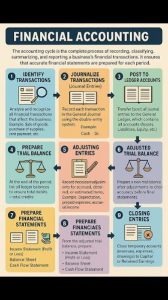
Accounting professionals analyze data to identify:
- Trends
- Risks
- Opportunities
- Performance indicators
This interpretation helps organizations make informed decisions.
Understanding Financial Statements
Financial statements are among the most important outputs of accounting systems.
Income Statement
The income statement, also known as the profit and loss statement, summarizes revenues and expenses over a specific period.
It answers one critical question:
Is the business making money?
Key components include:
- Revenue
- Cost of goods sold
- Operating expenses
- Net income
Balance Sheet
The balance sheet provides a snapshot of financial position.
It includes:
Assets
Resources owned by the business, such as:
- Cash
- Inventory
- Buildings
- Equipment
Liabilities
Financial obligations such as:
- Loans
- Accounts payable
- Taxes owed
Equity
The owner’s residual interest after liabilities are deducted from assets.
Cash Flow Statement
The cash flow statement tracks the movement of cash into and out of a business.
It highlights:
- Operating activities
- Investing activities
- Financing activities
This statement is essential for understanding liquidity and financial flexibility.
Major Types of Accounting
Accounting is a diverse profession with several specialized branches.
Financial Accounting
Financial accounting focuses on preparing reports for external stakeholders such as investors and lenders.
Its primary goal is transparency and compliance with accounting standards.
Managerial Accounting
Managerial accounting supports internal decision-making.
Managers use accounting information to:
- Set budgets
- Forecast revenue
 Evaluate performance
- Improve efficiency
Cost Accounting
Cost accounting analyzes production costs and operational expenses.
It helps businesses:
- Control costs
- Improve profitability
- Optimize resource allocation
Tax Accounting
Tax accounting focuses on compliance with tax laws and regulations.
Professionals help businesses and individuals:
- Calculate tax liabilities
- Prepare tax returns
- Minimize tax risks
- Plan tax strategies
Auditing
Auditors examine financial records to ensure accuracy and compliance.
Auditing enhances trust among investors, regulators, and stakeholders.
Accounting in Different Industries
Every industry depends on accounting, but applications vary.
Agriculture and Farming
Farmers often rely on loans, seasonal income, and fluctuating commodity prices.
Accounting helps them:
- Track production costs
- Manage debt
- Monitor profitability
- Plan future investments
Manufacturing
Manufacturers use accounting to:
- Calculate production costs
- Manage inventory
- Improve efficiency
- Control waste
Retail Businesses
Retail accounting focuses on:
- Sales tracking
- Inventory management
- Profit margin analysis
- Customer trends
Healthcare Organizations
Hospitals and clinics require sophisticated accounting systems to manage:
- Insurance reimbursements
- Payroll expenses
- Medical equipment investments
- Regulatory compliance
The Digital Transformation of Accounting
Technology has revolutionized accounting practices.
Cloud Accounting
Cloud-based accounting systems allow businesses to access financial information from anywhere.
Benefits include:
- Real-time reporting
- Improved collaboration
- Enhanced security
- Lower infrastructure costs
Artificial Intelligence and Automation
AI-powered accounting solutions can:
- Process invoices
- Detect anomalies
- Reconcile accounts
- Generate reports
Automation reduces human error and increases efficiency.
Data Analytics
Modern accountants use advanced analytics tools to uncover trends and predict future performance.
Predictive analytics enables organizations to make proactive business decisions.
Blockchain Technology
Blockchain is emerging as a tool for secure financial recordkeeping.
Potential benefits include:
- Greater transparency
- Enhanced security
- Reduced fraud
- Improved audit trails
Common Accounting Challenges
Despite technological advancements, accounting professionals face several challenges.
Regulatory Compliance
Businesses must comply with evolving accounting standards and government regulations.
Failure to comply can result in penalties and reputational damage.
Cybersecurity Risks
As financial systems become digital, protecting sensitive financial data becomes increasingly important.
Economic Uncertainty
Inflation, market volatility, and global economic disruptions create challenges for financial forecasting and planning.
Data Accuracy
Even sophisticated systems require accurate data entry and ongoing monitoring to maintain reliability.
The Future of Accounting
The accounting profession continues to evolve rapidly.
Future trends include:
- Increased automation
- Greater use of artificial intelligence
- Real-time financial reporting
- Advanced predictive analytics
- Enhanced cybersecurity measures
- Greater focus on sustainability reporting
Rather than replacing accountants, technology is transforming their role from data processors into strategic business advisors.
Modern accountants are expected to combine financial expertise with technological skills, analytical thinking, and business strategy.
Why Every Organization Needs Strong Accounting Practices
Organizations that maintain effective accounting systems enjoy numerous advantages.
These include:
- Better financial control
- Improved decision-making
- Increased profitability
- Regulatory compliance
- Greater investor confidence
- Enhanced operational efficiency
- Sustainable long-term growth
Conversely, poor accounting practices can lead to financial losses, legal issues, fraud, and business failure.
Accounting is not merely a back-office function; it is a strategic asset that drives organizational success.
Conclusion
Accounting is often called the language of business because it communicates the financial health and performance of an organization in a clear, structured, and meaningful way. From personal budgeting and household finances to multinational corporations and government institutions, accounting influences virtually every economic activity.
Modern accounting goes far beyond bookkeeping. It provides essential insights into profitability, cash flow, risk management, compliance, and strategic planning. Advances in technology, including cloud computing, artificial intelligence, automation, and data analytics, have elevated accounting into a powerful decision-making tool capable of shaping the future of organizations worldwide.
Whether managing a personal bank account, operating a small business, or leading a global enterprise, understanding and applying sound accounting principles is critical for financial success. In an increasingly complex and competitive economy, accounting remains one of the most valuable disciplines for achieving transparency, accountability, and sustainable growth.