
 By admin
The Strategic Golfer’s Guide: A Modern, Data-Driven Blueprint for Optimal Equipment Selection
Introduction
In the ever-evolving world of golf, mastering the game requires far more than technical skill and consistent practice—it demands an intelligent relationship with your equipment. Long gone are the days when golfers selected clubs based solely on brand loyalty or the latest marketing claim. Today, the modern golfer has access to advanced fitting technologies, data-driven insights, artificial intelligence–enhanced design, and an unprecedented variety of clubs engineered for specific swing types and performance goals.
Yet despite this wealth of information, many golfers continue to make equipment purchases impulsively, wasting money on clubs that are mismatched to their mechanics or developmental stage. For new players, the equipment landscape can feel overwhelming; for experienced ones, expensive trial-and-error cycles often lead to frustration and stagnation.
This modern guide transforms that confusion into clarity. Whether you are a beginner purchasing your first clubs, an improving golfer seeking targeted performance upgrades, or a seasoned competitor looking for cutting-edge personalization, this comprehensive blueprint shows you how to invest strategically instead of reactively.
With a structured approach—starting from foundational equipment and evolving toward advanced customization—you’ll learn how to build a set that supports your technique, optimizes ball-striking consistency, and fuels long-term improvement. The result is not only lower scores, but also a more rewarding and confident golfing experience driven by intelligent, data-centric choices.
I. Laying the Foundation: Building Your First Reliable Golf Arsenal
Choosing your first set of golf equipment sets the tone for your learning journey. Instead of chasing premium or professional-level gear, the priority at this early stage is consistency, comfort, and forgiveness. Your ultimate goal is to acquire tools that let you refine the fundamentals without unnecessary complexity or financial burden.
A. The Starter Set Paradigm: Why Simplicity Wins for Beginners
One of the first challenges new golfers face is deciding whether to buy or rent. At first glance, renting seems cost-efficient, but in reality, it introduces a major obstacle: inconsistency. Each time you rent, you are likely using clubs of varying lengths, flexes, and head designs—preventing your body from forming predictable swing patterns.
1. Advantages of Owning a Starter Set
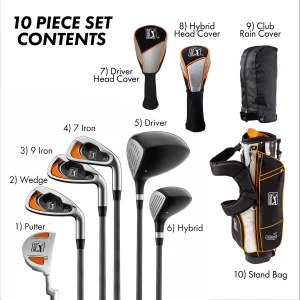
A modern starter set typically includes:
- A forgiving driver
- A fairway wood
- One or two hybrids
- Irons from 6–9
- A pitching wedge
- A putter
These sets are intentionally built for beginners, offering:
- Large sweet spots for off-center hits
- Perimeter weighting for stability
- Flexible shafts that help launch the ball higher
- High moment of inertia (MOI) to reduce twisting on mishits
By removing variability, your muscles can lock in a repeatable motion—one of the most important factors in early development.
2. The Hidden Cost of Poorly Matched Equipment
Using clubs that are too long, too stiff, or too heavy forces beginners into awkward compensations. These bad habits can take months or years to unlearn. A well-matched starter set prevents mechanical flaws before they develop.
B. The Critical Role of Basic Fitting: A Non-Neglectable Essential
Even beginners benefit immensely from a quick, basic fitting session. These short evaluations help ensure your clubs match your physical attributes and initial swing characteristics.
1. Height and Wrist-to-Floor Measurements
This determines whether you need:
- Standard length
- Half-inch extensions
- Shortened shafts
Proper length helps you maintain a natural posture and prevents spine-related swing issues.
2. Shaft Flex and Swing Tempo
Swing speed dictates your ideal shaft flex:
- L / A flex – slow tempos
- Regular – moderate speeds

- Stiff / Extra stiff – faster and athletic swings
Using the wrong flex can sabotage your performance:
- Too stiff → low ball flight, loss of distance
- Too flexible → ballooning shots, directional inconsistency
A 15-minute fitting dramatically accelerates your growth by aligning equipment with your biomechanics.
II. The Evolution Phase: Upgrading Toward a Personalized Performance Kit
Once your fundamentals stabilize, your equipment should evolve with your game. This stage is about refinement, optimization, and replacing generic beginner tools with gear tailored to your shot patterns, strengths, and weaknesses.
A. Upgrading the Driver: The Centerpiece of Modern Customization
The driver is often the first club golfers upgrade because it offers the most immediate return on investment in both distance and dispersion control.
1. Loft Adjustability and Its Impact on Performance
Most modern drivers include adjustable hosels that modify:
- Loft
- Face angle
- Lie angle
General guidelines:
- Higher loft (10.5°–12°) = higher launch, more carry, more forgiveness
- Lower loft (8°–9°) = lower spin for fast swing speeds
A proper loft setting can add 10–20 yards of carry instantly.
2. Advanced Shaft Engineering
Today’s driver shafts vary in:
- Weight (light for speed, heavy for control)
- Torque (twist resistance)
- Kick point (launch influence)
A professional fitting uses launch monitor data such as:
- Ball speed
- Launch angle
- Spin rate
- Smash factor
Dialing in the optimal shaft is often more impactful than changing the clubhead entirely.
3. Head Shape, MOI, and Forgiveness Levels
Some driver heads are designed for forgiveness; others for workability:
- High-MOI heads → straighter, more stable shots
- Compact “Tour” heads → allow shaping fades and draws
Golfers should choose based on their consistency level and shot preferences.
B. Refining the Scoring System: Irons, Wedges, and Putter
As your ball-striking improves, your scoring tools become far more important than your long game.
1. Irons: Choosing the Right Style for Your Skill Level
Three main categories exist:
- Cavity-back irons – forgiving, ideal for most golfers
- Players’ distance irons – blend forgiveness with feel
- Blades – for highly skilled ball-strikers
Most golfers thrive with cavity-back or players’ distance irons rather than blades.
2. Wedges: Building a Versatile Short-Game Arsenal
A modern wedge setup normally includes:
- Gap wedge (50°–52°)

- Sand wedge (54°–56°)
- Lob wedge (58°–60°)
Key wedge factors:
- Bounce angle for turf interaction
- Sole grinds for creativity
- Spin technology for stopping power
The wedge system should match:
- Your angle of attack (steep vs. shallow)
- Course conditions (firm vs. soft turf, fluffy vs. compact sand)
3. Putter Fitting: The Underrated Game Changer
Since the putter is used for 35–45% of strokes, proper fitting transforms scoring ability. Fitters analyze:
- Length
- Lie angle
- Toe hang
- Stroke arc
- Alignment aids
Upgrading your putter—especially with fitting—can lower your scores faster than upgrading any other club.
III. The Cutting Edge: Precision Engineering and Personalization for Maximum Performance
In the advanced stage of your golfing journey, every detail matters. Technology now allows everyday golfers to access customization once reserved solely for touring professionals.
A. The Modern Golf Ball Revolution: Selecting the Right Model for Your Game
Many golfers underestimate the golf ball, yet it influences distance, accuracy, spin, and feel on every shot.
Four Major Categories of Golf Balls
- Tour Performance Balls
- Urethane cover, multi-layer construction
- High short-game spin, maximum control
- Tour Distance Balls
- Low spin off the driver, moderate greenside control
- Soft Feel Balls
- Low compression for moderate swing speeds
- Straight / Max Distance Balls
- Two-piece construction, ultra-durable
- Ideal for high-handicap players wanting predictable distance
Choosing a single model and sticking with it is essential for consistency.
B. Launch Monitors: Data-Driven Mastery
Tech such as TrackMan, GCQuad, and FlightScope has transformed club fitting. They provide:
- Spin axis
- Dynamic loft
- Club path and face angle
- Impact location
- Ball speed and smash factor
This data removes the guesswork and ensures precision-matched equipment.
C. Emerging Trends: AI, 3D Printing, and Bespoke Shafts
1. AI-Designed Clubfaces
Manufacturers use artificial intelligence to simulate thousands of impacts, creating:
- Variable face thickness zones
- Optimized sweet spots
- More forgiveness on toe and heel hits
2. Additive Manufacturing (3D Printing)
3D printing allows:
- Perfect weight distribution
- Unique geometries
- Enhanced shock absorption
It is increasingly used in putters and high-end prototypes.
3. Custom Shaft Profiling
Cutting-edge shaft fitting analyzes:
- Load patterns
- Release speed
- Transition smoothness
Golfers receive shafts matched precisely to their motion—not just their swing speed.
Conclusion: Equip Smarter, Play Better, Enjoy More
Selecting golf equipment is not merely about buying clubs—it is about building a system that supports your performance at every stage of your development. From your first starter set to advanced custom-built components guided by launch monitor data, each decision influences your technique, confidence, and enjoyment.
A strategic approach prevents wasted spending and accelerates improvement:
- Beginners benefit from consistency and basic fitting.
- Improving golfers thrive with targeted upgrades—especially to the driver, wedges, and putter.
- Advanced golfers unlock maximum potential through personalized fittings, AI-enhanced design, and premium materials.
By viewing your equipment journey as a long-term investment rather than a series of impulsive purchases, you turn the art and science of golf into a powerful, enjoyable, and efficient pursuit.
Equip intelligently, refine continuously, and savor every moment on the course.
The Comprehensive Benefits of Aqua Fitness