
 By admin

The Global Time Zone System: Origins, Variations, and Implications
Introduction
Time is a universal constant that governs every aspect of human life, from daily routines to international business operations. However, the way time is measured and observed varies significantly across the globe due to the establishment of time zones. These variations are not arbitrary but are deeply rooted in the Earth’s rotation, historical developments, and political decisions. This article explores the reasons behind the differences in time across countries, delving into the scientific, historical, and geopolitical factors that have shaped the global timekeeping system. By understanding these intricacies, we gain insight into the challenges and complexities of coordinating time in an increasingly interconnected world.
The Earth’s Rotation and the Concept of Time Zones
The primary reason for differing times across countries lies in the Earth’s rotation. As the planet rotates on its axis from west to east, different regions experience sunlight at varying times, creating the cycle of day and night. To standardize timekeeping, the world is divided into 24 time zones, each spanning approximately 15 degrees of longitude. This division corresponds to a one-hour difference in time, ensuring that local times align with the sun’s position in the sky.
This system provides a consistent framework for daily activities, from scheduling work hours to coordinating international travel. Without time zones, the world would face chaos, as each locality would operate on its own solar time, leading to confusion in communication and transportation.
Historical Development of Time Zones
Before the adoption of standardized time zones, local mean time was the norm. Each community set its clocks based on the sun’s position at noon, resulting in a patchwork of local times. This system worked in a pre-industrialized world but became increasingly problematic with the advent of railways and telegraphs in the 19th century. The need for a unified time system became evident to avoid scheduling conflicts and ensure efficient transportation and communication.
In 1884, the International Meridian Conference in Washington, D.C., marked a turning point in global timekeeping. Delegates from 25 nations agreed to establish the Greenwich Meridian (0 degrees longitude) as the prime meridian, with Greenwich Mean Time (GMT) serving as the global reference point. This decision laid the foundation for the modern time zone system, enabling countries to synchronize their clocks based on a common standard.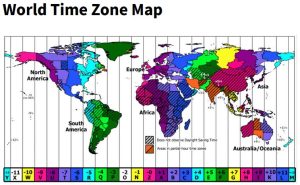
The Role of Longitude in Time Calculation
Longitude is a critical factor in determining local time. The Earth is divided into 360 degrees of longitude, and as it completes a full rotation every 24 hours, each 15-degree segment corresponds to a one-hour time difference. Locations east of the prime meridian are ahead in time, while those to the west are behind.
For example, if it is noon at the prime meridian, a location 15 degrees east would experience 1:00 PM, while a location 15 degrees west would see 11:00 AM. This principle ensures that time zones align with the Earth’s rotation, providing a logical and consistent framework for global timekeeping.
Variations and Anomalies in Time Zones
While the theoretical division of time zones is straightforward, practical implementations are influenced by political, economic, and social factors, leading to variations and anomalies.
Political Boundaries and Time Zones
Countries often adjust their time zones to align with political boundaries and economic centers. For instance, China, despite spanning five geographical time zones, observes a single standard time (China Standard Time, UTC+8) to promote national unity. Similarly, India uses a single time zone (Indian Standard Time, UTC+5:30) for the entire country, despite covering two geographical time zones.
Half-Hour and Quarter-Hour Offsets
Some regions adopt time zones with half-hour or quarter-hour differences from GMT. For example, Nepal observes a time offset of UTC+5:45, while the Chatham Islands in New Zealand use UTC+12:45. These offsets are often chosen to better align with local solar time or for political reasons.
Daylight Saving Time (DST)
Daylight Saving Time (DST) is another factor that complicates global timekeeping. Many countries advance their clocks during warmer months to extend evening daylight, reducing energy consumption and promoting outdoor activities. However, DST is not universally adopted, and its implementation varies widely, adding another layer of complexity to global time coordination.
The International Date Line and Time Differences
The International Date Line (IDL), located approximately along the 180-degree longitude, serves as the boundary where the calendar date changes. Crossing the IDL from west to east results in subtracting a day, while crossing from east to west adds a day. This line ensures a consistent calendar date across the globe but also leads to significant time differences between neighboring regions.
For example, the time difference between the Line Islands (part of Kiribati) at UTC+14 and Baker Island (an unincorporated territory of the United States) at UTC−12 is 26 hours, despite their geographical proximity. This substantial difference arises because the Line Islands are on the western side of the IDL, while Baker Island is on the eastern side.
Challenges and Considerations in Global Timekeeping
The current system of time zones, while functional, presents challenges in our interconnected world. Coordinating international meetings, travel, and communications requires careful consideration of time differences. Technological advancements have led to proposals for a unified global time system. For instance, some experts suggest adopting Coordinated Universal Time (UTC) worldwide to eliminate confusion caused by time zone differences. However, such a change would require significant adjustments in societal routines and is a topic of ongoing debate.
Conclusion
The variation in time across different countries is a result of the Earth’s rotation, historical agreements, and political decisions. Understanding the intricacies of time zones not only highlights the complexity of global timekeeping but also underscores the importance of synchronization in our modern, interconnected society. As we continue to advance technologically and socially, the discourse on how we measure and standardize time remains a pertinent and evolving conversation.