
 By admin
Introduction
On June 3, 1965, the United States achieved a significant milestone in the history of space exploration. Orbiting 193 kilometers (120 miles) above the Earth aboard Gemini 4, astronaut Edward H. White II became the first American to perform an extravehicular activity (EVA), commonly known as a spacewalk. This pivotal moment marked the United States’ determined stride in the Cold War-era Space Race, symbolizing not only technological progress but also national pride and ambition. While not the first human ever to walk in space—an honor that belongs to Soviet cosmonaut Alexei Leonov—White’s EVA was a defining moment for NASA, setting the stage for future manned missions and eventually, the Moon landing.
This article delves into the details of Edward White’s historic spacewalk, the broader context of the Gemini 4 mission, the geopolitical tension of the era, the mission’s scientific objectives, and White’s tragic legacy. It also underscores the symbolic and strategic significance of this landmark achievement in the American journey to space.
The Cold War Space Race: An Era of Intense Rivalry
Soviet Firsts and American Determination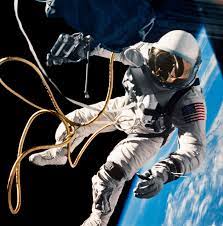
By the mid-1960s, the Space Race had become one of the most visible and high-stakes dimensions of the Cold War. Following the Soviet Union’s surprise launch of Sputnik in 1957, the first artificial satellite to orbit the Earth, the United States accelerated its efforts in space exploration. The Soviets maintained a lead through a series of groundbreaking firsts—including the first human in space, Yuri Gagarin, in 1961, and the first spacewalk by Alexei Leonov on March 18, 1965.
White’s spacewalk came just 11 weeks after Leonov’s EVA, serving as a clear response from NASA to regain momentum and demonstrate American capability and resolve. Though second in timeline, White’s spacewalk was longer and more controlled, earning recognition as a technical triumph and a powerful demonstration of American aerospace engineering.
The Gemini 4 Mission: Laying the Groundwork for the Moon
The Gemini Program: Bridging Mercury and Apollo
NASA’s Gemini program was developed to serve as an intermediate step between the pioneering Mercury missions and the ambitious Apollo program. The objectives of Gemini included testing long-duration spaceflight, precision rendezvous and docking, and EVAs—all vital for future lunar missions.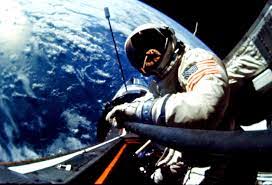
Gemini 4, launched on June 3, 1965, was the second manned mission of the Gemini program and the first American flight to last more than a single day. Commanded by astronaut James McDivitt with Edward White as pilot, the mission had both technical and symbolic objectives: conduct the first American spacewalk and demonstrate the U.S.’s growing capabilities in manned space operations.
Mission Duration and Objectives
Gemini 4 lasted four days and made 66 orbits around the Earth. This was the longest American spaceflight at the time and helped researchers better understand the physical and psychological impacts of extended time in space. Among the key objectives were:
-
Extravehicular Activity (EVA): Successfully deploying a human outside the spacecraft.
-
Orbital Maneuvering: An attempt to rendezvous with the spent Titan II rocket booster (though unsuccessful due to limited maneuvering capabilities).
-
Scientific Experiments: Conducting medical, photographic, and technological experiments to prepare for future missions.
Edward H. White II: America’s First Spacewalker
The Man Behind the Milestone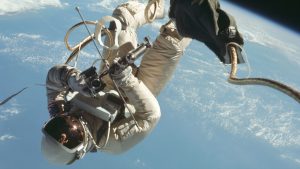
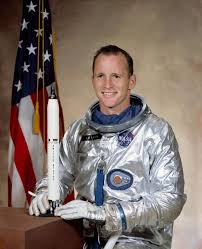
Edward Higgins White II was a U.S. Air Force officer, test pilot, and astronaut. Known for his dedication, technical expertise, and physical fitness, White was selected as a NASA astronaut in 1962. His athleticism and calm demeanor made him an ideal candidate for performing the first American EVA.
The Historic Spacewalk
At 3:45 p.m. EDT on June 3, 1965, 22 minutes into the second orbit of Gemini 4, Edward White opened the hatch of the spacecraft and floated into the vacuum of space. He was tethered to the spacecraft by a 25-foot (7.6-meter) umbilical cord that served both as a lifeline and communication conduit. In his right hand, he held a handheld maneuvering unit—a small jet propulsion device that released bursts of oxygen to allow him to control his movement.
White’s spacewalk lasted approximately 23 minutes. During that time, he floated freely, moved about with impressive grace, and even performed slow somersaults in microgravity. His exhilaration was evident in his communications with Mission Control. At one point, when instructed to re-enter the capsule, White jokingly remarked, “I’m coming back in… and it’s the saddest moment of my life.”
Technical Challenges and Triumphs
The Engineering Behind the EVA
The Gemini 4 spacewalk required significant planning and innovation. The pressure suit worn by White was a modified version of the G4C spacesuit, specifically reinforced for vacuum exposure and mobility. The spacecraft had to be redesigned with a hatch that could be opened and closed by the astronauts themselves—a technical first for American missions.
Despite its success, the EVA highlighted some challenges. White struggled to re-enter the spacecraft, and McDivitt had to assist in sealing the hatch. The EVA exposed limitations in maneuvering, suit flexibility, and spacecraft ergonomics, all of which informed the design of subsequent missions.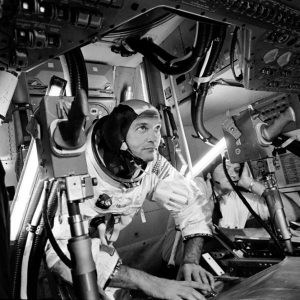
Scientific Gains
Gemini 4 also allowed for various experiments, including:
-
Medical monitoring: Assessment of cardiovascular responses to weightlessness.
-
Radiation exposure: Measuring cosmic radiation effects on the human body.
-
Earth observations: Capturing high-resolution photographs of cloud formations and geological features.
A Symbol of American Ambition
Media Coverage and Public Perception
White’s EVA captured the imagination of the American public. The footage of his floating form against the blackness of space, connected by a thin tether, became an iconic image. It symbolized both the fragility and courage of humanity venturing beyond Earth.
The U.S. media hailed the event as a triumph, contrasting it with Soviet secrecy. Unlike Leonov’s EVA, which was not shown in full to the public until much later, NASA broadcast White’s spacewalk almost in real time, demonstrating transparency and fostering public engagement with the space program.
Tragedy and Legacy
Apollo 1 Disaster
Edward White’s promising career was tragically cut short. On January 27, 1967, during a pre-launch test for Apollo 1 (AS-204), a cabin fire engulfed the spacecraft, killing White and fellow astronauts Gus Grissom and Roger Chaffee. The tragedy shocked the nation and led to sweeping safety reforms at NASA.
Honoring White’s Contribution
Edward H. White II is remembered as a pioneer and national hero. His name appears on schools, roads, and even on the lunar surface—where Apollo 11 astronauts left a memorial plaque honoring him and other fallen space explorers. His bravery, professionalism, and historical significance remain etched in the annals of space history.
Conclusion
Edward H. White II’s spacewalk on June 3, 1965, stands as a defining moment in America’s journey into space. Though preceded by the Soviet Union’s Alexei Leonov, White’s EVA represented a crucial technical achievement and a bold statement of intent from a nation eager to lead in space exploration. The Gemini 4 mission not only proved that astronauts could survive and function outside their spacecraft but also laid the groundwork for more ambitious endeavors, including the Apollo missions and the eventual Moon landing.
White’s courage, captured in his words and his smile during those 23 minutes of free-floating above Earth, continues to inspire generations of engineers, scientists, and dreamers. His tragic death just two years later underscores the risks of space exploration but also the unyielding spirit that drives humanity to reach beyond its limits.
Tracing the Legacy of the Infinity Symbol