
 By admin
Introduction
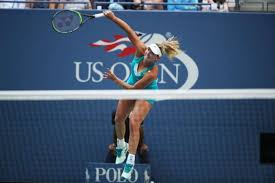
In the modern game of tennis, speed, power, and precision define success, but few areas of the court offer as much immediate authority as the net. The volley and the overhead smash represent tennis at its most aggressive and decisive. These strokes are the sport’s heavy artillery—designed not merely to sustain rallies, but to end points decisively. Whether in singles or doubles, the ability to dominate the net separates elite competitors from baseline specialists who lack finishing power.
While contemporary tennis often emphasizes baseline exchanges and heavy topspin, the net game remains an irreplaceable strategic weapon. Players who master volleys and overhead smashes force opponents into defensive positions, shrink reaction time, and control court geometry. This article explores the technical foundations, biomechanics, tactical principles, and modern applications of volleying, overhead smashing, and their natural counterstroke—the lob.
By blending classical tennis wisdom with current professional insights, this guide provides a comprehensive understanding of how net play continues to shape winning tennis at the highest level.
1. The Net Attack: Tennis’s Ultimate Point-Ending Strategy
The net attack exists for one purpose: to win points immediately. Unlike baseline rallies, which often rely on attrition, the volley and smash compress time and space, leaving the opponent with minimal opportunity to recover.
At the net, hesitation is fatal. Every volley or overhead must be approached with a point-winning mindset. Defensive thinking has no place here—except in rare transitional situations. Successful net players understand that once they commit forward, every ball becomes an opportunity to attack.
In modern tennis, the net attack is often built through intelligent approach shots rather than constant serve-and-volley play. Heavy topspin approaches, deep slice approaches, and well-placed serves all create openings that allow the volleyer to finish efficiently.
2. Footwork and Body Positioning at the Net
Although volleying shares many biomechanical principles with groundstrokes, the realities of net play demand adaptation. Time is compressed, and perfect stance alignment is often impossible.
Key Footwork Principles:
- Shift body weight toward the ball
- Step with the foot closest to the ball
- Maintain balance and readiness
- Keep movements compact and economical
Rather than striving for textbook positioning, effective volleyers prioritize reaction speed and directional balance. The forward push of the body supplies most of the shot’s energy, eliminating the need for excessive swing motion.
3. Types of Volleys: Height and Intent
Volleys can be classified based on contact height and tactical purpose.
3.1 Low Volleys
Low volleys are contacted below the waist and are among the most challenging strokes in tennis.
Characteristics:
- Executed with a blocking motion
- No full swing or follow-through
- Emphasis on control and placement
- Typically angled or dropped short
Because of the net’s height, low volleys should rarely be hit hard. Instead, sharp angles and soft hands create winning opportunities.
3.2 High Volleys
High volleys are struck between waist and head height and offer greater offensive potential.
Characteristics: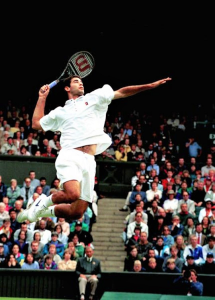
- Can be blocked or lightly hit
- Allow controlled acceleration
- Ideal for depth or decisive angles
- Minimal follow-through
Any ball contacted above net height presents a chance to attack aggressively.
4. Deep Volleys vs. Stop Volleys
Beyond height, volleys are also defined by intent.
4.1 Deep Volleys
Deep volleys are driven into open court spaces to push opponents back or force weak replies. These are essential when opponents are positioned behind the baseline.
4.2 Stop Volleys
The stop volley is a subtle, highly effective weapon. It involves absorbing the ball’s pace rather than adding force.
Key elements:
- Soft grip pressure
- Minimal racquet movement
- Slight backspin to reduce bounce
- Short placement near the net
Executed correctly, the stop volley leaves the opponent helpless, even at full sprint.
5. Proper Racquet Technique: No Chop, No Wrist
One of the most misunderstood aspects of volleying is racquet movement. Despite popular misconceptions, volleys should never be chopped downward aggressively.
A chopping motion increases the risk of popping the ball upward, offering opponents an easy passing shot. Instead, effective volleys are made with the racquet face traveling nearly along the ball’s flight path.
Critical Technical Rules:
- Racquet face slightly open
- Minimal swing path
- Contact in front of the body
- Controlled forward push
Just as important is wrist stability. The wrist must remain locked and firm, positioned below the racquet head. The combined force of the incoming ball and body weight does the work—attempting to “flick” the ball invites errors.
6. Placement Over Power: The Geometry of Volleying
Volleying is governed by a simple geometric truth: the straight line is the shortest distance between two points.
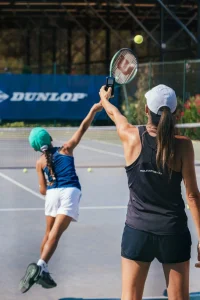
This principle defines net strategy. The volleyer must:
- Cover the straight passing lane
- Force opponents into low-percentage angles
- Return volleys directly into open court spaces
Fancy curving shots or risky angles give opponents time to recover. Elite volleyers instead “punch” the ball decisively and directly to its target.
7. Offensive Mindset at the Net
Once positioned at the net, the goal is not survival—it is domination.
Tactical Guidelines:
- Attack every feasible volley
- Follow the ball after contact
- Recover quickly to cover the line
- Force opponents to attempt difficult passing shots
Defensive volleys are acceptable only when balls are struck at the feet during approach. Otherwise, every volley should apply pressure.
8. The Overhead Smash: Tennis’s Ultimate Finisher
Closely related to the volley, yet distinct in execution, the overhead smash is tennis’s most powerful weapon. Often described as the “Big Bertha” of the sport, the overhead should almost always result in a winning point.
8.1 Footwork and Positioning
The same positional principles that govern volleys apply to overheads:
- Quick adjustment steps
- Side-on stance
- Balanced base
- Eyes locked on the ball
Unnecessary jumping should be avoided. Keeping at least one foot on the ground enhances balance and directional control.
8.2 The Swing Mechanics
The overhead swing resembles a slice serve:
- Arm and racquet swing freely from the shoulder
- Wrist remains flexible
- Racquet face remains square
- Slight spin helps control depth

Power is generated through full extension and smooth acceleration, not brute force.
9. Common Overhead Errors and How to Fix Them
Missed overheads typically fall into two categories:
- Loss of visual focus – taking the eyes off the ball
- Lack of confidence – resulting in a hesitant or shortened swing
The solution is commitment. Overheads require a full, confident swing with complete follow-through. Half-swings lead to errors far more often than full, aggressive strokes.
10. Overheads in Singles vs. Doubles
The overhead smash is particularly valuable in doubles, where two players cover the net efficiently. In singles, passing shots are often more effective than lobs, making overheads less frequent but still critical.
In doubles:
- Lobs are commonly used to disrupt net positioning
- Overheads open the court dramatically
- Crosscourt smashes offer safer margins
When under pressure, smashing crosscourt increases safety due to greater net clearance and court length.
11. Never Retreat When You Can Smash
Allowing a lob to bounce instead of smashing is a strategic error. Retreating cedes attacking position and invites opponent control.
Key rules:
- Smash whenever possible
- Avoid reverse twists
- Hit with a square racquet face
- Direct shots to open court spaces
Confidence at the net discourages opponents from attempting future lobs.
12. The Lob: The Natural Counter to Net Play
The lob exists as the primary defense against aggressive net attacks. While defensive by nature, it can also become an offensive surprise.
12.1 What Defines an Effective Lob?
- Lands between service line and baseline
- Ideally within six feet of the baseline
- Forces the net player backward
12.2 Purposes of the Lob
- Regain court position
- Break opponent rhythm
- Fatigue aggressive net players
- Occasionally win outright through placement
13. Types of Lobs: Chop vs. Flat
13.1 Chop Lob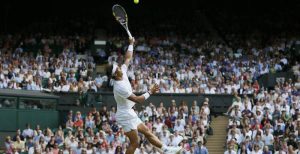
The chop lob uses heavy underspin, sending the ball high—often 20 to 30 feet in the air.
Benefits:
- Maximum recovery time
- Disrupts timing
- Forces deep court movement
It is the most reliable defensive lob.
13.2 Flat or Stroke Lob
The flat lob carries light topspin and travels lower and faster.
Characteristics:
- Rarely exceeds 10 feet in height
- Difficult to chase down
- Ideal for surprise winners
This lob begins like a groundstroke but softens just before contact.
14. Strategic Value of the Lob
The lob’s greatest strength lies in psychological disruption. An unexpected, perfectly executed lob at a critical moment can shift momentum instantly.
It is often better to lob long than short. A deep lob forces movement and fatigue, while a short lob gifts confidence and opportunity.
Conclusion
The volley and overhead smash remain timeless pillars of effective tennis. While baseline play dominates modern rallies, matches are still won by players who can finish points decisively at the net. Mastery of volley technique, strategic placement, disciplined footwork, and confident overhead execution transforms net play into a lethal weapon.
Equally important is understanding the lob—both as a defensive necessity and an offensive surprise. Together, these strokes form a complete net-based arsenal that challenges opponents physically, mentally, and tactically.
In an era of power and spin, the player who controls the net still controls the match.
Celebrating the Greatest Women in Sports