
 By admin
The Invisible Web: An In-Depth Exploration of How Wireless Networks Power the Modern Digital World
Introduction
In the contemporary digital era, where instant communication and uninterrupted connectivity have become fundamental expectations rather than luxuries, wireless networks stand as one of the most transformative technological achievements of modern civilization. From personal smartphones and laptops to industrial automation systems, smart cities, autonomous vehicles, and billions of Internet of Things (IoT) devices, wireless communication silently orchestrates the flow of information that defines how societies function today.
Unlike traditional wired networks that rely on physical cables, wireless networks transmit data invisibly through the air using electromagnetic waves. This seemingly simple concept conceals an extraordinarily complex ecosystem of physics, engineering, software protocols, and international standards. Every video stream, cloud backup, voice call, or smart-home command depends on precise synchronization between hardware components, spectrum allocation, security mechanisms, and data transmission techniques operating at near-light speed.
This comprehensive guide aims to uncover the inner workings of modern wireless networks, moving beyond surface-level explanations to explore the technologies that enable speed, reliability, scalability, and security. By examining how digital data is converted into radio waves, how frequencies and channels are managed, how devices coordinate access to shared airspace, and how emerging standards like Wi-Fi 7 and 5G redefine connectivity, this article provides a detailed understanding of the invisible infrastructure shaping our digital future.
I. The Fundamental Principles of Wireless Communication
1. Digital Data and Binary Foundations
All wireless communication originates from digital data expressed in binary form—streams of ones and zeros representing text, images, audio, or video. Computers and smart devices operate exclusively in this digital domain, processing information through electrical signals inside microprocessors.
However, binary data cannot travel through the air in its raw form. To enable wireless transmission, digital information must be transformed into a format compatible with electromagnetic propagation. This transformation marks the first critical step in wireless networking and serves as the bridge between the digital and physical worlds.
2. Modulation: Converting Bits into Radio Waves
The process of converting digital data into transmittable radio signals is known as modulation. In this process, a high-frequency carrier wave is modified according to the binary data being sent. The most common modulation techniques include:
- Amplitude Modulation (AM): Varying the strength of the signal
- Frequency Modulation (FM): Varying the frequency
- Phase Modulation (PM): Shifting the phase of the signal
Modern wireless technologies use advanced modulation schemes such as Quadrature Amplitude Modulation (QAM), which combines amplitude and phase variations to transmit multiple bits per signal change. Higher-order QAM (e.g., 1024-QAM or 4096-QAM in Wi-Fi 7) dramatically increases data throughput but requires cleaner signal conditions.
Once modulated, these radio waves are emitted by an antenna and propagate through space, where receiving antennas capture and demodulate them back into digital data.
II. The Radio Frequency Spectrum: The Invisible Highway
1. Understanding the RF Spectrum
The radio frequency (RF) spectrum is a finite and highly regulated portion of the electromagnetic spectrum used for wireless communication. Different frequency ranges possess unique characteristics that influence signal range, speed, and penetration capabilities.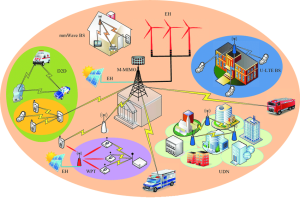
Lower frequencies travel farther and penetrate obstacles more effectively, while higher frequencies support faster data rates but have shorter ranges. Efficient wireless networking depends on balancing these trade-offs.
2. Key Frequency Bands in Modern Wireless Networks
- 2.4 GHz Band:
Widely used and compatible with most devices, offering extended range but limited bandwidth and higher interference. - 5 GHz Band:
Provides higher speeds and more non-overlapping channels, ideal for high-performance applications but with reduced range. - 6 GHz Band (Wi-Fi 6E and Wi-Fi 7):
Introduces vast amounts of clean spectrum, enabling ultra-wide channels and minimal interference for next-generation applications. - Millimeter Wave (mmWave):
Used in advanced 5G deployments, offering extreme data rates over short distances.
3. Channels, Bandwidth, and Spectrum Efficiency
Wireless bands are divided into channels, each representing a specific frequency range. Channel width directly affects performance:
- 20 MHz (basic stability)
- 40 MHz and 80 MHz (high-speed consumer Wi-Fi)
- 160 MHz and 320 MHz (Wi-Fi 6E and Wi-Fi 7)
Wider channels allow faster data transfer but require careful management to avoid interference. Modern standards optimize spectrum usage through intelligent channel allocation and adaptive bandwidth selection.
III. Advanced Transmission Technologies
1. OFDMA: Efficient Multi-User Communication
Orthogonal Frequency-Division Multiple Access (OFDMA) revolutionized wireless efficiency by subdividing channels into smaller subcarriers. This allows a single access point to serve multiple devices simultaneously, reducing latency and improving performance in high-density environments such as offices, stadiums, and smart cities.
2. MU-MIMO: Parallel Data Streams
Multi-User Multiple Input Multiple Output (MU-MIMO) technology enables routers to transmit different data streams to multiple devices at the same time using multiple antennas. This significantly enhances throughput and ensures fair access for all connected devices.
3. Beamforming and Smart Antennas
Beamforming focuses wireless signals directly toward connected devices rather than broadcasting in all directions. This targeted approach improves signal strength, reduces interference, and enhances energy efficiency—particularly valuable in modern mesh networks and enterprise deployments.
IV. Wireless Network Architecture and Components
1. Wireless Access Points (APs)
Access points serve as the central communication hubs in wireless local area networks (WLANs). Enterprise-grade APs support advanced features such as:
- Load balancing
- Seamless roaming
- Network segmentation
- Centralized cloud management
2. Wireless Routers and Gateways
Consumer wireless routers combine routing, switching, firewall protection, and wireless access in a single device. Modern routers integrate AI-driven traffic optimization, parental controls, and cybersecurity features.
3. Mesh Networking Systems
Mesh networks consist of multiple interconnected nodes that create a unified wireless environment. Unlike traditional extenders, mesh systems dynamically route traffic between nodes, ensuring consistent coverage, high reliability, and seamless mobility across large spaces.
4. Client Devices and Network Interfaces
Client devices—including smartphones, laptops, wearables, and IoT sensors—use wireless network interface controllers (WNICs) to communicate with access points. Each device negotiates connection parameters such as modulation, channel width, and security settings dynamically.
V. Wireless Standards and Protocols
1. The IEEE 802.11 Family
Wireless interoperability relies on standardized protocols defined by the IEEE. Each generation improves performance, efficiency, and reliability:
- Wi-Fi 4 (802.11n): Introduced MIMO
- Wi-Fi 5 (802.11ac): Enabled gigabit speeds
- Wi-Fi 6 / 6E (802.11ax): Optimized dense environments
- Wi-Fi 7 (802.11be): Ultra-low latency, multi-link operation, and extreme throughput
2. Multi-Link Operation (MLO)
Wi-Fi 7 introduces Multi-Link Operation, allowing devices to transmit data simultaneously across multiple frequency bands. This enhances reliability, reduces latency, and improves performance for real-time applications such as AR, VR, and cloud gaming.
VI. Wireless Security and Data Protection
1. Encryption Standards
Wireless data must be encrypted to prevent interception. Security protocols have evolved significantly:
- WEP: Obsolete and insecure
- WPA / WPA2: Stronger encryption but increasingly vulnerable
- WPA3: Current gold standard with enhanced encryption and protection against brute-force attacks
2. Authentication and Network Segmentation
Enterprise environments often use 802.1X authentication, digital certificates, and RADIUS servers to verify user identities. Network segmentation isolates devices, reducing the impact of potential breaches—especially important for IoT ecosystems.
VII. Beyond Wi-Fi: Expanding Wireless Ecosystems
1. Cellular Networks (4G, 5G, and Beyond)
Cellular networks provide wide-area wireless connectivity. 5G introduces three transformative pillars:
- Enhanced Mobile Broadband (eMBB)
- Ultra-Reliable Low-Latency Communications (URLLC)
- Massive Machine-Type Communications (mMTC)
These capabilities support autonomous vehicles, telemedicine, smart infrastructure, and industrial automation.
2. Low-Power Wide-Area Networks (LPWAN)
Technologies such as LoRaWAN and NB-IoT enable long-range, energy-efficient communication for sensors and smart devices, often operating for years on a single battery.
Conclusion
Wireless networks represent one of the most sophisticated technological ecosystems ever developed, seamlessly blending physics, engineering, software design, and global cooperation. What appears to users as effortless connectivity is, in reality, the result of decades of innovation in modulation techniques, spectrum management, hardware architecture, security protocols, and international standardization.
As technologies such as Wi-Fi 7, advanced 5G, future 6G research, and massive IoT deployments continue to evolve, wireless networks will become even more intelligent, adaptive, and deeply integrated into daily life. Understanding how these invisible systems operate not only highlights their complexity but also underscores their essential role in shaping a faster, smarter, and more connected world.
Why Windows Uninstallation Fails