
 By admin
The Fascinating History of Moroccan Medjool Dates and Their Rise to Global Dominance
Introduction
Few fruits in the world carry a legacy as rich and fascinating as the Medjool date. Often referred to as the “King of Dates,” this exceptional fruit is prized for its large size, luxurious texture, and naturally rich sweetness. Although the Medjool date originated in Morocco’s historic Tafilalet Valley, today it is cultivated across multiple continents, with global production dominated by countries far from its birthplace.
The journey of the Medjool date—from a treasured fruit grown in Moroccan oases to a globally traded agricultural commodity—is a story of exploration, colonial science, agricultural innovation, and international markets. A single historical event in the early twentieth century ultimately transformed the geography of Medjool cultivation and reshaped the global date industry.
This article explores the fascinating story of Moroccan Medjool dates, tracing their origins in North Africa, their introduction to the United States, their worldwide expansion, and the modern efforts to restore Morocco’s position in the global Medjool market.
The Origins of the Medjool Date in Morocco
The Tafilalet Oasis: Birthplace of the Medjool
The Medjool date originated in the historic oasis region of Tafilalet in southeastern Morocco. Located near the city of Errachidia, this region has been one of North Africa’s most important date-growing areas for centuries.
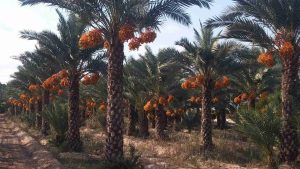
Tafilalet’s unique environment—characterized by arid desert conditions, fertile oasis soils, and an abundance of underground water—creates ideal conditions for cultivating date palms. For generations, Moroccan farmers cultivated numerous varieties of dates, but the Medjool stood apart due to its exceptional size, flavor, and texture.
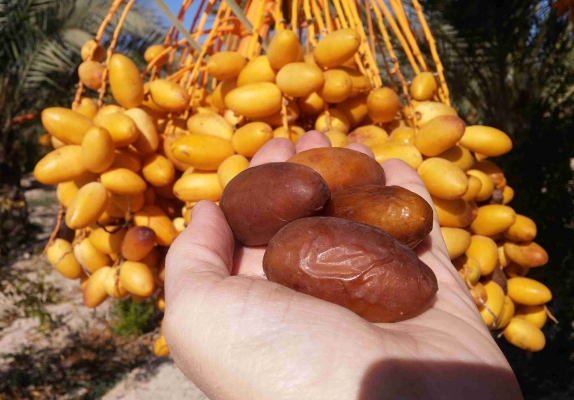
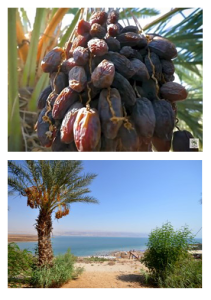
Unlike many other date varieties, the Medjool is known for producing large fruits that can weigh between 20 and 40 grams each. The fruit features a distinctive amber to dark brown skin when ripe, along with a thick, soft, translucent flesh that is rich, sweet, and almost fiberless. Its wrinkled texture and characteristic wing-shaped pit make it easily recognizable.
Because of these qualities, Medjool dates have long been considered a luxury product in Moroccan culture and international markets.
Historical References to Medjool Dates
Historical accounts confirm that the Medjool date has been cultivated in Morocco for centuries. One of the earliest written mentions appears in a seventeenth-century travel account by the Moroccan scholar Al-Arabi Mizin.
In his writings about the Tafilalet region, he noted the harvesting season of various date varieties and specifically mentioned the Medjool date, highlighting its unique harvest schedule. According to his account, most date harvesting in the region began on October 1, while Medjool dates were harvested earlier, sometimes as early as September 17.
This historical record shows that the Medjool variety was already well established and recognized for its distinct agricultural characteristics more than three hundred years ago.
A Luxury Fruit in Early International Markets
Medjool Dates as a Premium Export Product
During the nineteenth and early twentieth centuries, Medjool dates became known beyond Morocco’s borders. European merchants and traders discovered the fruit and quickly recognized its commercial potential.
Due to their rarity and exceptional quality, Medjool dates were considered a luxury product. They were often sold in elegant gift boxes in major European cities such as Paris, Madrid, and London, especially during the Christmas season.
Consumers viewed them as an exotic delicacy from North Africa, similar to other rare imported foods that symbolized prestige and refinement.
Early Agricultural Recognition
Agricultural experts and botanists were also fascinated by the Medjool date. According to agricultural descriptions compiled by international organizations such as the Food and Agriculture Organization (FAO), the Medjool variety stands out among date cultivars because of several distinctive characteristics:
- Extremely large fruit size
- Thick and fleshy texture
- Rich caramel-like sweetness
- Low fiber content
- Long shelf life
- High market value
These attributes would later make the Medjool date one of the most commercially valuable date varieties in the world.
However, the global expansion of Medjool dates was not initially driven by commerce. Instead, it began because of a devastating agricultural crisis.
The Bayoud Disease Crisis
A Devastating Fungal Epidemic
In the early twentieth century, Moroccan date palm plantations were struck by a devastating disease known as Bayoud disease.
The disease is caused by a fungus called Fusarium oxysporum f. sp. albedinis, which attacks the vascular system of date palms and ultimately kills the tree. Once infected, a palm tree cannot recover, and the disease spreads rapidly across plantations.
Bayoud disease became particularly destructive in the Tafilalet region, where many of Morocco’s finest Medjool palm trees were located.
By the 1920s, the epidemic had begun destroying large numbers of Moroccan date palms, threatening the survival of several valuable date varieties.
Scientific Investigation
Concerned about the economic and agricultural impact of the disease, French colonial authorities in Morocco launched a scientific investigation to study the outbreak.
A team of international scientists was assembled to examine the disease and develop strategies for controlling its spread. Among the researchers involved was American botanist Walter Tennyson Swingle, a specialist in tropical agriculture.
During his visit to Morocco, Swingle became deeply impressed by the quality and potential of the Medjool date. Recognizing its agricultural value, he decided to preserve the variety by transporting several offshoots—young shoots capable of producing new palm trees—to the United States.
This decision would ultimately reshape the global date industry.
The American Introduction of Medjool Dates
Transporting the Offshoots to the United States
In the late 1920s, Swingle transported eleven Medjool offshoots from Morocco to the United States. These offshoots included six full-sized shoots and five smaller ones.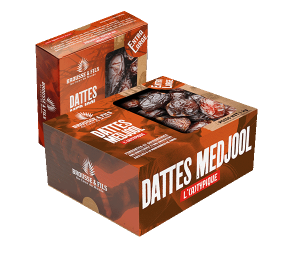
Upon arrival in Washington, D.C., the plants underwent strict quarantine procedures to prevent the introduction of agricultural diseases into the United States.
They were eventually transferred to a quarantine facility in Nevada, a region chosen specifically because it had no existing date palm plantations.
The quarantine process lasted nearly a decade—from 1927 to 1936.
Survival and Transfer to California
At the end of the quarantine period, nine of the original eleven offshoots had survived. These surviving plants were then transferred to an agricultural research station operated by the United States Department of Agriculture in Indio, California.
Researchers at the station began cultivating the plants and producing additional offshoots. Over time, the trees adapted remarkably well to the desert climate of California’s Coachella Valley and Arizona’s Yuma region.
These environments, with their hot temperatures and dry conditions, closely resembled the natural climate of Morocco’s oasis regions.
The Expansion of Medjool Cultivation in North America
Distribution to Farmers
In 1944, the USDA research station in Indio began distributing Medjool offshoots to American farmers.
This marked the beginning of large-scale Medjool cultivation outside Morocco.
One of the major agricultural companies involved in early cultivation was the Bard Company in California. The company acquired 24 offshoots and began expanding production in the region.
Today, approximately 99% of date palms grown in areas such as Yuma, Arizona, and California’s Bard Valley are Medjool varieties descended from those original Moroccan plants.
Building a New Agricultural Industry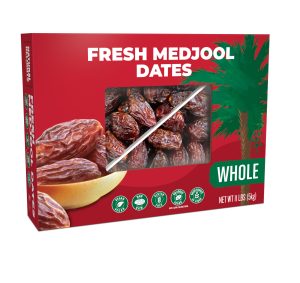
Over the following decades, Medjool cultivation expanded rapidly in the United States. Farmers discovered that the fruit commanded high prices in international markets, especially among consumers seeking premium natural foods.
Advancements in irrigation technology, desert agriculture, and cold storage allowed the industry to grow steadily.
By the late twentieth century, the United States had become one of the world’s largest producers of Medjool dates.
The Global Expansion of Medjool Dates
Spread to Other Countries
Once established in the United States, the Medjool date began spreading internationally.
In 1968, offshoots from American plantations were introduced into Mexico’s San Luis Río Colorado–Mexicali Valley.
Israel began importing the variety during the 1950s and expanded its cultivation during the 1970s. Between 1978 and 1981 alone, Israel imported approximately 9,000 Medjool offshoots from California.
In the following decades, additional countries adopted the variety, including:
- Jordan
- Palestine
- South Africa
- Namibia
- Australia
- Peru
- Chile
- Sudan
Modern biotechnology later accelerated this expansion through tissue culture techniques, allowing laboratories to produce thousands of genetically identical Medjool palm seedlings.
This innovation dramatically increased global production capacity.
The Rise of Global Production Leaders
Shifting Production Away from Morocco
Despite being the birthplace of the Medjool variety, Morocco eventually lost its dominant position in global production.
The devastating impact of Bayoud disease destroyed large portions of the country’s traditional date palm groves, significantly reducing production capacity.
Meanwhile, countries that had adopted Medjool cultivation—particularly the United States and Israel—expanded their plantations rapidly.
By the mid-1990s, approximately 100,000 Medjool palm trees across the United States and Israel were already supplying global markets with about 1,000 tons of fruit annually.
Modern Production Statistics
By 2020, global Medjool production had increased dramatically, reaching tens of thousands of tons annually.
Israel emerged as the leading producer, generating approximately 45,000 tons per year—representing over 40% of global production.
Other major producers included:
- United States: around 16,000 tons
- Mexico: about 15,000 tons
- Palestine: approximately 12,000 tons
- Jordan: around 10,000 tons
In contrast, Morocco produced only about 3,500 tons, accounting for roughly 3% of global production.
Additional production came from countries such as South Africa, Namibia, and Egypt.
The Global Medjool Market Today
A High-Value Agricultural Product
Today, Medjool dates represent one of the most valuable segments of the global date market.
According to recent agricultural studies, global exports of Medjool dates reach approximately 67,000 tons annually, generating nearly $470 million in revenue.
Demand continues to grow steadily, with annual growth rates estimated between 5% and 10%.
The European Union remains one of the largest markets for premium Medjool dates, receiving roughly one-quarter of global exports.
Consumers increasingly view Medjool dates as a natural sweetener, a healthy snack, and an ingredient in gourmet cuisine.
Culinary and Nutritional Appeal
The popularity of Medjool dates is driven not only by their flavor but also by their nutritional benefits.
They are rich in:
- Natural sugars
- Dietary fiber
- Potassium
- Magnesium
- Antioxidants
Because of these properties, Medjool dates are widely used in healthy diets, plant-based cooking, energy snacks, and desserts.
Their reputation as a “superfood” has further increased demand worldwide.
Morocco’s Strategy to Reclaim Its Heritage
Revitalizing the Date Industry
Recognizing the historical and cultural importance of Medjool dates, Morocco has launched several initiatives to revitalize its date palm sector.
Government programs aim to expand plantations, improve irrigation systems, and support farmers in oasis regions.
A major focus has been the introduction of disease-resistant palm varieties and the replanting of Medjool palms.
Currently, approximately 67% of newly planted date palms in Morocco belong to the Medjool variety.
Ambitious Production Goals
Morocco hopes to dramatically increase its Medjool production in the coming years.
National agricultural plans aim to expand output to around 70,000 tons by 2028, potentially restoring the country as a major player in the global Medjool market.
If these goals are achieved, Morocco could once again become one of the leading producers of the fruit that originally grew in its desert oases.
Conclusion
The story of the Medjool date is one of the most fascinating agricultural journeys in modern history. Originating in Morocco’s Tafilalet oasis centuries ago, this extraordinary fruit became globally famous thanks to a combination of historical circumstances, scientific curiosity, and international agricultural development.
A devastating fungal disease in the early twentieth century inadvertently led to the global spread of the Medjool variety when a small number of Moroccan palm offshoots were transported to the United States. From those few plants, entire industries were built across North America and the Middle East.
Today, countries such as Israel, the United States, and Mexico dominate global production, while Morocco—its birthplace—produces only a small share of the world’s Medjool dates.
However, Morocco is actively investing in the revival of its historic date industry. With new plantations, modern agricultural techniques, and increasing global demand, the country may yet reclaim a leading role in the global Medjool market.
The Medjool date remains not only a symbol of agricultural excellence but also a powerful reminder of how history, science, and global trade can transform a local fruit into a worldwide delicacy.
The Real World of Chinese Cuisine