
 By admin
Introduction
In the last decade, artificial intelligence (AI) has transitioned from being a futuristic concept to becoming an essential driver of innovation, efficiency, and business growth. Today, AI tools—especially generative AI, intelligent automation systems, and data-driven agents—are reshaping how employees work, how companies manage resources, and how decisions are made. The promise of AI goes far beyond automation: it unlocks time, optimizes workflows, and empowers organizations to evolve their operational models toward agility, precision, and high-value output.
As companies face increasing market competition, talent shortages, and growing customer expectations, AI technologies provide a timely and transformative solution. From supporting strategic decision-making to enhancing customer experiences, AI has become a core component of modern productivity systems. This article explores the key advantages of AI tools for productivity, explains how they reshape work environments, and highlights 11 powerful AI tools that companies can start using today.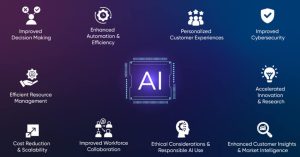
Enhancing Productivity Through AI: Key Advantages and Strategic Benefits
1. Optimizing Resource Allocation Through Intelligent Automation
1.1 Saving Time to Focus on High-Value Tasks
One of the most significant benefits of AI tools is their ability to save time—often hours per week—by automating repetitive, low-value tasks. Both generative AI and intelligent automation technologies can handle processes that were traditionally manual, labor-intensive, or prone to human error. This time savings can be reinvested into strategic, creative, and analytical work where employees offer true added value.
Modern AI tools streamline workflows by:
- Automating document drafting and content creation
- Handling data extraction and classification
- Managing scheduling and administrative tasks
- Organizing information for quick retrieval
- Assisting in research, analysis, and reporting
According to recent global surveys, a large majority of employees using generative AI report saving over 5 hours per week. Interestingly, 41% use this extra time to increase their output, while 39% spend it on entirely new tasks. This shift represents a profound transformation in modern work culture, making AI a catalyst for higher productivity and greater job satisfaction.
1.2 Reducing Costs and Improving Workforce Efficiency
AI-powered automation tools reduce operational costs by minimizing the time employees spend on routine tasks and lowering the margin of error. As workflows become more efficient, employees can focus on innovative or customer-facing activities—improving productivity as well as job fulfillment.
Examples of productivity-boosting AI automation include:
- AI-powered CRM platforms that categorize leads automatically
- Intelligent email assistants that summarize conversations
- AI-driven task managers that create schedules or workflows
- Data-processing bots that handle long back-office procedures
This rationalization of processes leads to better resource allocation, optimized budgeting, and improved employee well-being.
1.3 Beyond Generative AI: A Broader Technological Landscape
Since the rise of ChatGPT, generative AI has quickly become the most visible form of artificial intelligence. However, companies must recognize that AI encompasses many other categories: machine learning, predictive analytics, process automation, intelligent agents, and robotics. Working with AI experts helps companies identify the most suitable technologies and avoid implementing tools that add complexity rather than value.
2. Rethinking Business Processes for Continuous Improvement
2.1 Identifying Inefficiencies Through AI Analytics
AI tools are redefining business operations by identifying inefficiencies and recommending improvements. Organizations can now revise their workflows with real-time data, predictive insights, and continuous process optimization. For example:
- AI supply chain platforms improve inventory management, forecast demand, and reduce transportation costs.
- Intelligent workflow engines detect bottlenecks in approval processes, customer support operations, and logistics.
- Predictive algorithms estimate workload distribution and dynamically assign tasks to the most suitable resources.
These enhancements create more fluid and resilient organizational structures.
2.2 Optimizing Workflows Without Transforming Business Models
AI agents can improve existing workflows without requiring companies to change their entire operational model. Intelligent agents perform low-value tasks instantly and on command, allowing employees to focus on priorities that require human judgment and creativity. Examples include:
- Automatically updating dashboards
- Summarizing customer interactions
- Preparing meeting notes
- Extracting insights from PDFs or spreadsheets
AI agents act as invisible assistants that continuously enhance workflow fluidity, improving operational speed and accuracy.
2.3 Gaining a Competitive Advantage Through Proper AI Adoption
Florian Douetteau, CEO of Dataiku, highlights that a company’s productivity can increase up to tenfold when AI technologies are used properly across the right domains. He also warns that businesses ignoring AI risk falling behind competitors who embrace intelligent technologies. This emphasizes the importance not only of adopting AI—but adopting it strategically.
3. Supporting Smarter and Faster Decision-Making
3.1 Leveraging Data-Driven Insights
AI provides advanced analytical capabilities that help leaders make decisions based on accurate, real-time data rather than intuition. With AI, companies can transform raw data into actionable insights, improving strategic planning and operational forecasting. Benefits include:
- Enhanced accuracy in financial projections
- Improved risk assessment
- Better resource and workforce planning
- Faster detection of anomalies and opportunities
AI strengthens decision-making both practically and psychologically: leaders gain confidence knowing their choices are backed by solid, quantifiable information.
3.2 Improving Data Collection and Organization
Before analysis comes data collection—an area where AI tools also excel. AI systems gather, structure, and categorize data from multiple sources, reducing the time spent on manual data entry. This speeds up research processes and ensures access to high-quality data that supports better decision-making across departments.
4. Delivering Personalized and High-Value Customer Experiences
4.1 Transforming Customer Interactions Through AI Personalization
Thanks to AI-driven data collection, companies can optimize customer engagement strategies and deliver highly personalized experiences. Intelligent chatbots, for example, can:
- Automatically qualify leads
- Provide personalized product recommendations
- Respond instantly to customer inquiries
- Offer guided support without human intervention
These conversational AI systems rely on supervised learning, making them increasingly accurate and empathetic. Their rise is transforming digital customer service into a more fluid, responsive experience.
4.2 The Business Value of Personalization
By 2025, 96% of marketing executives believe that personalized experiences significantly increase sales performance. In a digital marketplace where customers demand speed and relevance, personalization has become a key differentiator—and AI is the most effective tool for scaling it.
11 Powerful AI Tools to Boost Productivity
Below is a modernized overview of some of the most widely adopted AI tools used today to enhance performance in content creation, analytics, scheduling, and automation.
1. ChatGPT
- Main Function: Conversational AI agent
- Price: €229/month
- Alternatives: Gemini (Google), Claude, Perplexity, Mistral, Copilot
- Use Cases: Content creation, research, task automation, code assistance
2. Breeze
- Main Functions: Conversational agent, business process automation, analytics
- Price: Variable
- Alternatives: Salesforce Einstein, Brevo Aura, Zoho Zia, Freshsales Freddy
3. MAIA
- Main Function: AI writing assistant
- Price: €12/month
- Alternatives: Grammarly
4. Fireflies
- Main Function: Meeting transcription
- Price: $10/month
- Alternatives: Krisp, Otter, Tactiq
5. ChatPDF
- Main Function: Document analysis
- Price: €8.25/month
- Alternatives: Youdoc, TextCortex, Acrobat AI Assistant
6. Beautiful.ai
- Main Function: Presentation creation
- Price: $12/month
- Alternatives: PopAI, Gamma
7. Reclaim
- Main Function: Intelligent scheduling
- Price: $8/month
- Alternatives: Clockwise
8. Notion AI
- Main Functions: Conversational AI, writing assistance, meeting transcription
- Price: €19.50/month
- Alternatives: ClickUp
9. SheetAI
- Main Function: AI-assisted spreadsheet creation
- Price: $20/month
- Alternatives: Rows
10. Canva
- Main Function: Graphic design
- Price: €12/month
- Alternatives: VistaCreate, Adobe Express
11. PlayPlay
- Main Function: Video creation
- Price: Variable
- Alternatives: Various advanced video-editing AI platforms
Conclusion
Artificial intelligence is no longer an optional innovation—it is a strategic imperative. By automating repetitive tasks, improving decision-making, optimizing business processes, and delivering personalized customer experiences, AI tools significantly enhance productivity across every industry. Organizations that embrace AI thoughtfully gain a competitive advantage, reduce operational costs, and empower employees to focus on meaningful, high-value work.
As AI technologies continue to evolve, companies that invest early will be best positioned to thrive in the intelligent economy of the future.
The Untold Story Behind Canva’s Success