
 By admin

Why Do Bees Build Their Honeycombs in Perfect Hexagons?
Introduction
One of nature’s most fascinating engineering marvels lies within a beehive. Open a hive, and you’ll find row after row of perfectly aligned hexagonal cells forming the honeycomb. Each cell is identical in size, shape, and angle, creating a flawless structure that has intrigued humans for centuries. From ancient philosophers like Pappus of Alexandria to modern-day scientists and mathematicians, the honeycomb pattern has been admired as a symbol of natural efficiency and beauty.
But why do bees choose the hexagon over other shapes such as circles, squares, or triangles? The answer lies at the intersection of biology, geometry, physics, and evolution. This article explores the reasons behind the hexagonal design of honeycombs, examining how this remarkable pattern maximizes efficiency, minimizes energy use, and contributes to the survival of bee colonies.
The Marvel of the Honeycomb
A Structure of Precision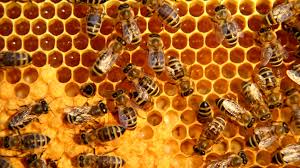
The honeycomb is not a random construction but a carefully organized system of wax cells that serve multiple purposes: storing honey, pollen, and housing larvae. Each hexagonal cell measures roughly the same, ensuring uniformity across the hive. This geometric consistency provides strength and stability to the entire structure.
Wax as a Precious Resource
Bees produce wax by secreting it from specialized glands. However, producing wax is energy-intensive: studies show that bees must consume about 8 kilograms of honey to produce just 1 kilogram of wax. Therefore, minimizing wax use while maximizing storage space is crucial for the hive’s survival. This is where the hexagon comes into play.
Why the Hexagon?
The Geometry of Efficiency
In geometry, only three regular shapes can tessellate a flat surface without leaving gaps: triangles, squares, and hexagons. Out of these, the hexagon has unique advantages:
- Circles waste space. If bees built circular cells, empty gaps would remain between them.
- Squares and triangles fit, but less efficiently. While they fill space without gaps, they require more wax per unit of storage volume.
- Hexagons are optimal. They provide the largest storage area with the least perimeter, meaning bees use less wax while maximizing capacity.
This principle, known as the Honeycomb Conjecture, was mathematically proven in 1999 by mathematician Thomas C. Hales, confirming that hexagonal tiling is the most efficient way to partition a plane.
Mechanical Strength and Stability
Beyond efficiency, hexagons offer mechanical advantages. The six-sided shape distributes weight evenly across the comb, allowing the structure to hold large amounts of honey without collapsing. Each cell wall is tilted slightly upward (around 13°), preventing liquid honey from dripping out.
Energy Conservation in Construction
Bees instinctively follow the hexagonal pattern, avoiding the need for complex calculations. Their collective behavior, guided by evolutionary instincts, allows them to build large combs quickly and with minimal wasted effort. The saved energy translates into higher productivity and better chances of colony survival.
The Science Behind the Honeycomb Pattern
The Honeycomb Conjecture in Mathematics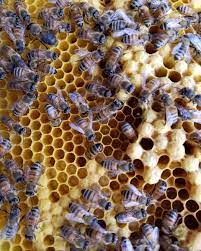
Mathematicians have long suspected that hexagons provide the most efficient way to fill space. The conjecture dates back to ancient Greek scholars who admired the honeycomb’s geometry. In the 20th century, rigorous mathematical proofs confirmed that hexagonal tiling minimizes the total perimeter for a given area, making it the best solution for bees seeking to maximize storage with minimal resources.
Physics of Wax Flow
Recent studies suggest that bees initially construct circular cells. As the wax warms due to the heat of the hive, surface tension forces transform these circles into hexagons, much like soap bubbles forming hexagonal patterns in clusters. This indicates that both bee behavior and physical laws contribute to the final shape.
Evolutionary Adaptation
Over millions of years, natural selection favored bees that built efficient combs. Colonies that wasted wax or energy were less likely to survive, whereas those that mastered hexagonal construction thrived. Today’s bees inherit this evolutionary advantage, building combs with instinctive precision.
Comparing Hexagons with Other Shapes
Hexagons vs. Circles
While circles enclose the maximum area for a given perimeter, they cannot tile a surface without gaps. Bees would need extra wax to fill those gaps, making circles impractical.
Hexagons vs. Squares
Squares tile perfectly but require more wax per unit of storage. Hexagons, with their slightly shorter perimeter relative to area, conserve resources better.
Hexagons vs. Triangles
Triangles also tessellate without gaps, but they create sharp corners and less efficient use of space. Bees would need more wax to build triangular cells, reducing efficiency.
Beyond Bees: Where Nature and Humans Use Hexagons
Hexagons in Nature
The honeycomb isn’t the only example of h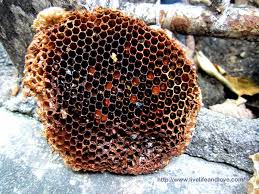 exagons in the natural world. Other phenomena demonstrate the same efficiency principle:
- Giant’s Causeway in Ireland – basalt rock columns naturally form hexagonal patterns as lava cools.
- Snowflakes – their crystalline structures are hexagonal due to water’s molecular bonding.
- Turtle shells and insect eyes – both exhibit hexagonal arrangements for maximum strength and coverage.
Human Inspiration from Honeycombs
Engineers, architects, and designers often borrow from honeycomb geometry:
- Aerospace engineering – honeycomb panels are lightweight yet strong, ideal for aircraft and spacecraft.
- Architecture – hexagonal tiling provides strength and aesthetics in flooring and design.
- Packaging – cardboard honeycomb structures are used to reinforce shipping materials.
Thus, bees have inspired human innovation, demonstrating how natural efficiency can be applied to modern challenges.
The Symbolism of the Hexagon
Cultural and Spiritual Meaning
Across cultures, the hexagon has been a symbol of harmony, balance, and interconnectedness. The honeycomb, in particular, represents community, cooperation, and productivity — values central to bee colonies. Ancient civilizations often saw the honeycomb as a sign of divine perfection in nature.
The Lesson from Bees
The hexagonal honeycomb is more than just a storage unit; it is a testament to teamwork, precision, and natural wisdom. Bees work collectively, each contributing to a structure that is stronger than the sum of its parts. For humans, the honeycomb serves as a reminder of the power of collaboration and efficient design.

Conclusion
The honeycomb’s hexagonal design is one of nature’s greatest examples of intelligent efficiency. Far from being a random choice, the six-sided structure is the result of millions of years of evolution, guided by geometry, physics, and natural selection. Hexagons allow bees to store the maximum honey with the least wax, build strong and stable structures, and conserve precious energy.
Modern science has confirmed what bees have always known: the hexagon is nature’s perfect shape for building. From mathematics to architecture, humans continue to learn from the honeycomb, applying its principles to solve modern problems. Ultimately, the honeycomb reminds us that even the smallest creatures can teach us profound lessons about efficiency, cooperation, and survival.
Protein and Kidney Failure in Dogs