
 By admin
Understanding the Size and Composition of the Sun: A Journey Through Astronomical Innovation
Introduction
The Sun, our closest star, has been a source of fascination and scientific inquiry for centuries. Despite the fact that no human-made object has ever reached its surface, astronomers have successfully determined its size, mass, and composition through a combination of observational techniques, mathematical principles, and physical laws. This article delves into the methodologies and discoveries that have enabled us to unravel the mysteries of the Sun, shedding light on its dimensions, makeup, and the cutting-edge technologies that continue to enhance our understanding.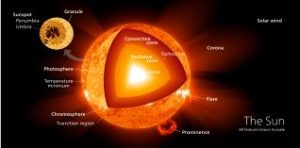
Determining the Sun’s Size
Historical Context and Early Observations
The quest to measure the Sun’s size dates back to ancient civilizations, where early astronomers observed solar and lunar eclipses to gain insights into the relative distances and sizes of the Earth, Moon, and Sun. However, it was the advent of geometric principles and telescopic technology that allowed for more precise calculations.
Modern Techniques: Angular Diameter and Trigonometry
One of the most fundamental methods for determining the Sun’s size involves measuring its angular diameter—the angle it subtends in the sky. By combining this measurement with the average distance between the Earth and the Sun (known as an astronomical unit or AU), scientists can calculate the Sun’s actual diameter using trigonometry. The average distance from Earth to the Sun is approximately 149.6 million kilometers, and the Sun’s angular diameter averages about 0.53 degrees. Using the formula:

This calculation reveals that the Sun’s diameter is approximately 1.392 million kilometers, making it about 109 times wider than Earth. Such precise measurements underscore the power of mathematical and observational techniques in astronomy.
Calculating the Sun’s Mass
Newton’s Law of Universal Gravitation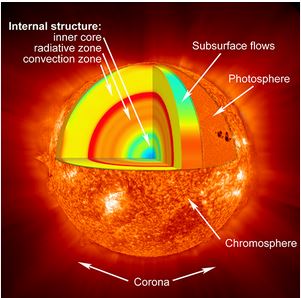
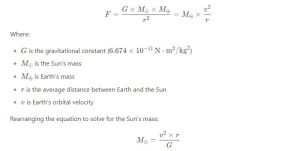
The determination of the Sun’s mass is rooted in Isaac Newton’s law of universal gravitation. By analyzing the orbital characteristics of planets, particularly Earth’s orbit, scientists can apply Newton’s laws to estimate the Sun’s mass. The gravitational force between the Sun and Earth keeps our planet in its nearly circular orbit, and this relationship can be expressed mathematically as:
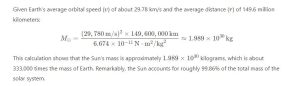
Unveiling the Sun’s Composition
Spectroscopy: The Key to Solar Composition
Understanding the Sun’s composition without direct sampling is a testament to human ingenuity. The primary method used to study the Sun’s makeup is spectroscopy—the analysis of the interaction between matter and electromagnetic radiation.
When sunlight is dispersed through a prism or diffraction grating, it produces a spectrum of colors. Superimposed on this continuous spectrum are dark lines known as absorption lines, first observed by Joseph von Fraunhofer in the early 19th century. These lines, called Fraunhofer lines, correspond to specific wavelengths where light is absorbed by elements in the Sun’s atmosphere.
Each chemical element absorbs light at characteristic wavelengths, creating a unique spectral fingerprint. By comparing the observed absorption lines with known wavelengths of elements measured in laboratory settings, scientists can identify the elements present in the Sun. This technique has revealed that the Sun is predominantly composed of hydrogen (~74% by mass) and helium (~24% by mass), with trace amounts of heavier elements such as oxygen, carbon, neon, and iron.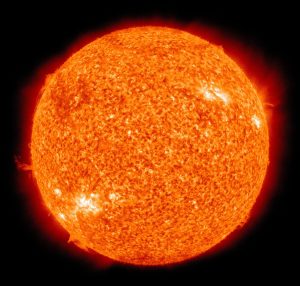
Advancements Through Space Missions
NASA’s Parker Solar Probe: Touching the Sun
While ground-based observations have provided substantial information, space missions have significantly enhanced our understanding of the Sun. One of the most notable missions is NASA’s Parker Solar Probe, launched in 2018. Designed to study the Sun’s outer corona, the probe has made unprecedented close approaches, coming within 6.16 million kilometers of the solar surface.
In April 2021, during its eighth perihelion, the Parker Solar Probe crossed the Alfvén surface—the boundary where the solar atmosphere transitions into solar wind. This milestone marked the first time a human-made object “touched” the Sun’s outer atmosphere, providing invaluable data on solar wind acceleration, magnetic fields, and energetic particles. The probe’s findings have offered insights into phenomena such as magnetic switchbacks—sudden reversals in the Sun’s magnetic field—and the dynamics of solar wind streams.
Challenges and Future Prospects
Overcoming Observational and Technical Challenges
Despite these advancements, studying the Sun remains a formidable challenge. The Sun’s intense brightness and the Earth’s atmospheric interference complicate ground-based observations. Additionally, the extreme temperatures and radiation levels near the Sun pose significant risks to spacecraft.
Future Missions: Solar Orbiter and Beyond
Future missions aim to address these challenges by leveraging advanced technologies and innovative approaches. For instance, the European Space Agency’s Solar Orbiter, launched in 2020, is designed to capture high-resolution images of the Sun’s poles and study its magnetic activity. These missions, combined with ongoing advancements in spectroscopy and computational modeling, promise to deepen our understanding of the Sun and its influence on the solar system.
Conclusion
The Sun, a seemingly simple ball of light in our sky, is a complex and dynamic star that has captivated scientists for centuries. Through a combination of observational techniques, mathematical principles, and cutting-edge technology, we have determined its size, mass, and composition with remarkable precision. Space missions like the Parker Solar Probe and Solar Orbiter continue to push the boundaries of our knowledge, offering new insights into the Sun’s behavior and its impact on the solar system. As we look to the future, the study of the Sun remains a vibrant and evolving field, promising to unlock even more secrets of our star.
Navigating the World of Air Purification