
 By admin
How Do Ants Walk on Walls Without Falling? A Fascinating Defiance of Gravity
Introduction
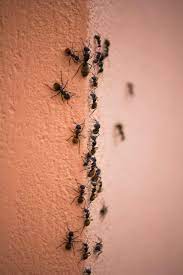
One of nature’s most fascinating spectacles is the sight of ants climbing vertical walls, ceilings, or even glass surfaces with remarkable ease. While humans and most animals struggle against the pull of gravity, ants appear to move effortlessly, as if defying the very laws of physics. This phenomenon has long intrigued scientists, leading to groundbreaking discoveries in biomechanics, adhesion, and insect physiology.
Understanding how ants achieve this gravity-defying feat is more than just a matter of curiosity. Their climbing mechanisms have inspired scientific research, robotics, engineering, and even the design of medical adhesives. In this article, we will explore the science behind ant locomotion, the biological structures that enable it, and how modern technology is learning from these tiny creatures.
The Secret Behind Ants’ Wall-Climbing Ability
The Role of Microscopic Claws
Ants are equipped with tiny hooked claws at the end of their legs. These claws act much like a mountaineer’s pickaxe, gripping into small cracks and surface irregularities that are invisible to the human eye. When ants walk on rough surfaces such as wood, stone, or concrete, their claws provide anchorage, preventing them from slipping.
Adhesive Pads for Smooth Surfaces
But claws alone are not enough to explain why ants can climb smooth walls, such as glass or polished tiles. For this, ants rely on adhesive pads located near their claws, known as arolia. These pads secrete a thin layer of liquid that creates capillary adhesion, similar to the effect of water holding two glass plates together.
This dual system—claws for rough textures and adhesive pads for smooth surfaces—gives ants a versatile climbing ability unmatched by most other animals.
The Science of Adhesion in Ants
Capillary Action and Surface Tension
When ants press their adhesive pads against a wall, they release a sticky liquid. This secretion forms a microscopic film between the pad and the surface. Due to surface tension and capillary forces, the liquid generates an adhesive effect strong enough to support the ant’s body weight.
Despite their small size, ants exert a surprisingly high adhesive force relative to their body mass. Research has shown that an ant can carry objects many times heavier than its own body while climbing vertically, thanks to this adhesion system.
The Power-to-Weight Ratio
Ants benefit from an extraordinary power-to-weight ratio. Since they are lightweight, the gravitational force pulling them down is minimal compared to their adhesive strength. This makes it possible for them to walk upside down or sideways on walls without falling.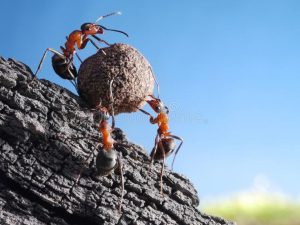
Comparative Insights: Ants vs. Other Insects
Geckos and Their Microscopic Hairs
Ants are not the only creatures capable of wall-climbing. Geckos, for instance, use millions of microscopic hairs called setae that exploit van der Waals forces to stick to surfaces. Unlike geckos, however, ants rely on a combination of claws and liquid adhesion.
Flies and Their Sticky Feet
Flies also climb walls using adhesive pads, but their pads are more specialized for glassy surfaces. Ants, by contrast, show greater versatility, allowing them to adapt to different terrains, from smooth walls to rough tree bark.
The Evolutionary Advantage of Wall-Climbing
Survival and Foraging
Wall-climbing gives ants a significant advantage in survival. By scaling vertical surfaces, ants can:
- Access food sources hidden in elevated areas.
- Escape predators by retreating to hard-to-reach spots.
- Build nests in tree trunks, ceilings, and other elevated structures.
Social Coordination in Colonies
Since ants are social insects that rely on teamwork, their climbing ability enhances the efficiency of the colony. Workers can transport food vertically, defend their nest from invaders, and expand their territory across multiple levels of terrain.
Applications in Modern Science and Technology
Biomimicry in Robotics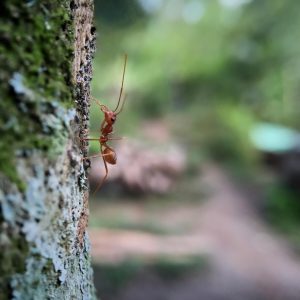
Engineers are studying ants to design climbing robots capable of scaling vertical walls in dangerous environments, such as collapsed buildings or industrial plants. By mimicking the structure of ant claws and adhesive pads, scientists are developing robots that can move with the same agility and stability.
Medical Adhesives Inspired by Ants
The liquid adhesion mechanism of ants is inspiring the creation of new medical adhesives. These could lead to surgical tapes and wound dressings that adhere firmly but can be removed without causing damage to the skin.
Nanotechnology and Material Science
The study of ant adhesion also contributes to nanotechnology and material engineering, leading to coatings, glues, and industrial materials that replicate nature’s efficiency in sticking to surfaces.
The Physics Behind the Feat
Gravity vs. Adhesion Forces
For an ant walking on a vertical wall, gravity constantly tries to pull it downward. However, the adhesion force between its pads and the surface is significantly stronger than the gravitational pull on its tiny body. This imbalance explains why ants do not fall, even when upside down.
Energy Efficiency
Remarkably, ants manage to achieve this with very little energy expenditure. Their adhesive system engages passively—meaning they do not need to continuously exert force to remain stuck. Instead, the physics of liquid adhesion and claw anchoring do most of the work.
Fascinating Experiments and Discoveries
High-Speed Cameras and Microscopy
Scientists have used high-speed cameras and electron microscopes to observe ant feet in action. These studies revealed how ants dynamically switch between claws and adhesive pads depending on the type of surface.
Strength Tests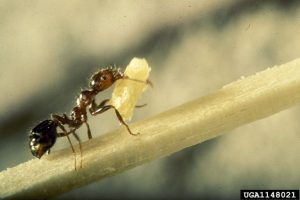
Experiments have shown that an ant’s adhesive strength can support loads 100 times its body weight. This is equivalent to a human carrying a small car while walking up a skyscraper wall.
Future Perspectives
Sustainable Engineering Solutions
By continuing to study ants, researchers hope to design sustainable adhesives that reduce the need for chemical glues, which often harm the environment.
Advancing Robotics for Exploration
Robots inspired by ant locomotion may one day explore dangerous terrains on Earth—or even extraterrestrial surfaces like Mars—where conventional wheeled vehicles struggle.
Conclusion
The ability of ants to walk on walls without falling is not magic, but the result of millions of years of evolutionary adaptation, biomechanical innovation, and the clever use of physics. Their microscopic claws, adhesive pads, and lightweight bodies allow them to navigate vertical and inverted surfaces with ease, giving them a survival edge in the natural world.
Beyond biology, the study of ant climbing behavior is shaping the future of robotics, medicine, and material science, proving once again that even the smallest creatures can inspire the greatest technological advances.
Next time you see an ant effortlessly walking across a wall or ceiling, remember: you are witnessing a masterclass in natural engineering—a tiny defiance of gravity that holds big lessons for humanity.
The Secrets Behind Dinosaur Reconstructions