
 By admin

Introduction
In the evolving landscape of digital marketing and search engine optimization (SEO), keyword density remains a fundamental concept. While the rules surrounding keyword usage have changed dramatically over the years, getting the balance right can still make a significant difference in how a webpage ranks on search engine results pages (SERPs). Understanding how keyword density works—and how to optimize it without overdoing it—is essential for anyone looking to improve their website’s visibility. In this article, we’ll dive deep into the meaning of keyword density, the correct way to calculate it, best practices for optimization, and why moderation is crucial in today’s SEO environment. 
What is Keyword Density?
Definition and Importance
Keyword density refers to the percentage of times a keyword or phrase appears in a piece of content relative to the total word count. It helps search engines determine the topic and relevance of a page. However, gone are the days when simply stuffing a page with keywords guaranteed high rankings. Modern algorithms are far more sophisticated and now prioritize natural, high-quality content that provides genuine value to users.
How Keyword Density Influences SEO
Appropriate keyword density can improve a webpage’s relevance to specific search queries, helping it to rank better. However, exceeding optimal density can trigger penalties for “keyword stuffing,” a practice seen as manipulative and spammy by search engines like Google.
How to Calculate Keyword Density
Basic Formula
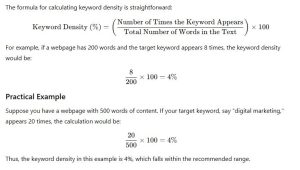
Practical Example
Suppose you have a webpage with 500 words of content. If your target keyword, say “digital marketing,” appears 20 times, the calculation would be:
20500×100=4%\frac{20}{500} \times 100 = 4\%
Thus, the keyword density in this example is 4%, which falls within the recommended range.
The Ideal Keyword Density Range
Recommended Standards
Experts agree that an ideal keyword density typically falls between 1% and 3%. Some older recommendations suggested 3% to 5%, but today’s best practices emphasize a slightly lighter touch to maintain content quality and avoid penalties.
Why You Shouldn’t Overdo It
Excessive keyword usage can result in poor readability, negatively impacting user experience and leading to high bounce rates. Furthermore, search engines may flag the content as spammy, resulting in decreased visibility or even delisting.
Modern SEO: Context Over Repetition
Emphasis on Semantic SEO
Modern SEO algorithms, like Google’s RankBrain and BERT, focus more on contextual relevance than on raw keyword counts. Instead of worrying solely about exact keyword matches, content creators are encouraged to use semantic variations, synonyms, and related terms.
Latent Semantic Indexing (LSI)
Latent Semantic Indexing (LSI) refers to the use of related words and phrases that naturally complement your main keyword. For instance, if your keyword is “keyword density,” related terms could include “SEO ranking,” “content optimization,” and “search engine algorithm.”
How to Measure Keyword Density: Step-by-Step Guide
Step 1: Copy the Webpage Content
Select the content from a specific webpage and copy it into a word processor like Microsoft Word or Google Docs.
Step 2: Count Total Words
Use the “Word Count” feature under the “Tools” menu to determine the total number of words on the page.
Step 3: Find Keyword Occurrences
Use the “Find and Replace” function:
-
Open “Find” (Ctrl+F).
-
Enter your target keyword.
-
Word processors will display how many times the keyword appears.
Step 4: Calculate Density
Divide the number of keyword instances by the total word count and multiply by 100 to get the density percentage.
Automated Tools for Checking Density
Several online tools simplify the process:
-
Yoast SEO (WordPress plugin)
-
SEMrush SEO Writing Assistant
-
Ahrefs Content Analyzer
-
SmallSEOTools Keyword Density Checker
These tools not only calculate density but also offer suggestions for improving keyword distribution.
Best Practices for Optimizing Keyword Density
Write Naturally First
Always prioritize natural writing. Focus on producing valuable, coherent, and engaging content before considering keyword insertion.
Strategic Placement Matters
Instead of worrying about quantity, place your keywords strategically:
-
In the title
-
In headings and subheadings
-
In the first 100 words
-
In the URL, if possible
-
In the meta description
-
Sparingly in the alt text of images
Use Variations and Synonyms
Rather than repeating the same phrase endlessly, mix in LSI keywords and related expressions. This approach not only helps with SEO but also enriches the content’s quality.
Avoid Keyword Cannibalization
Keyword cannibalization occurs when multiple pages on your site target the same keyword, causing them to compete against each other. Ensure each page has a unique focus keyword.
Common Mistakes to Avoid
Over-Optimization
Stuffing content with keywords results in a robotic tone and devalues user experience. Aim for balance and fluidity.
Ignoring User Intent
Focusing solely on keyword placement without understanding the user’s search intent can lead to irrelevant content. Ensure your writing answers real questions and solves real problems.
Forgetting About Mobile
Mobile-first indexing is now standard. Content should be optimized not just for keywords, but also for mobile readability—short paragraphs, clear headings, and easy navigation.
Keyword Density and Content Quality: Finding the Perfect Balance
While keyword density remains a fundamental SEO concept, it should never compromise the quality of your content. Today, search engines reward high-value, well-organized, and informative articles. Good keyword management enhances relevance and improves SEO, but the ultimate goal is to satisfy the reader’s needs.
When keywords are used thoughtfully—supported by semantic variations and a strong content structure—they contribute to both improved rankings and a superior user experience.
Conclusion
In today’s highly competitive digital landscape, mastering keyword density is crucial for SEO success—but it must be approached with strategy and restraint. Focus on providing valuable, engaging, and contextually rich content, while ensuring that your keywords enhance rather than dominate your writing. Remember, SEO is as much about people as it is about algorithms. By keeping keyword density between 1% and 3%, strategically placing keywords, and maintaining a natural flow, you can achieve better visibility, drive more organic traffic, and build lasting relationships with your audience.
What Is an MLM Business Model?