
 By admin
Understanding the Difference Between the Foreign Exchange Market and the Stock Market
Introduction
In today’s interconnected global economy, financial markets play a pivotal role in shaping investments, economic policies, and individual wealth. Among the most prominent financial arenas are the foreign exchange market (forex or FX market) and the stock market. While both serve as platforms for trading and investing, they are fundamentally different in their operations, participants, and scope.
Understanding these distinctions is crucial for investors, traders, and financial professionals aiming to diversify their portfolios and optimize financial strategies. This article explores the primary and nuanced differences between the foreign exchange market and the stock market, incorporating up-to-date information and practical insights into how each functions in the modern financial landscape.
The Foreign Exchange Market: A Global Financial Powerhouse
What is the Forex Market?
The foreign exchange market, often referred to as forex or FX, is a decentralized global marketplace for the trading of currencies. It is the largest and most liquid financial market in the world, with daily trading volumes exceeding $7.5 trillion as of 2024, according to the Bank for International Settlements (BIS).
Unlike centralized stock exchanges, forex trading occurs over-the-counter (OTC) via electronic communication networks, allowing participants from all over the world to trade directly with one another.
Participants in the Forex Market
The FX market attracts a broad range of participants, including:
-
Central banks and governments
-
Commercial and investment banks
-
Hedge funds and asset managers
-
Corporations conducting international business
-
Retail traders and brokers
These entities engage in currency trading for various reasons such as speculation, hedging, and international commerce.
Currency Pairs and Liquidity
In the forex market, currencies are traded in pairs (e.g., EUR/USD, USD/JPY). The first currency is known as the base currency, and the second is the quote currency. Traders speculate on the appreciation or depreciation of one currency relative to the other.
Liquidity is a defining characteristic of forex. Because of its enormous scale and round-the-clock operation, traders can enter or exit positions with minimal slippage or delays. This makes forex especially appealing for those looking for high-frequency trading opportunities.
The Stock Market: Equity Ownership and National Investment
What is the Stock Market?
The stock market is a collection of exchanges and markets where shares of publicly held companies are issued, bought, and sold. When investors purchase stock, they are acquiring equity ownership in a corporation.
Major global stock exchanges include:
-
New York Stock Exchange (NYSE)
-
NASDAQ
-
London Stock Exchange (LSE)
-
Tokyo Stock Exchange (TSE)
Each of these operates within specific national boundaries and trading hours, making stock trading geographically and temporally restricted compared to forex.
Participants in the Stock Market
Investors in the stock market include:
-
Individual retail investors
-
Institutional investors such as mutual funds and pension funds
-
Proprietary trading firms
-
Public corporations issuing stock
Participants often invest for long-term growth, dividends, or capital appreciation based on a company’s financial health and performance.
Asset Class and Ownership
Unlike forex, where currencies are traded, the stock market involves ownership of a company’s equity. This ownership may come with voting rights and entitlement to dividends, depending on the class of stock purchased. Stocks are tangible representations of corporate success or failure, influenced by earnings reports, industry trends, and macroeconomic factors.
Key Differences Between Forex and Stock Markets
1. Market Structure and Accessibility
Forex Market:
-
Decentralized and operates OTC.
-
Accessible 24 hours a day, five days a week.
-
Operates globally, spanning multiple time zones.
Stock Market:
-
Centralized and exchange-based.
-
Operates during specific hours tied to the local business day.
-
Restricted to national exchanges unless trading internationally via ADRs (American Depository Receipts) or cross-listings.
2. Volume and Liquidity
The forex market dwarfs the stock market in terms of daily trading volume. With over $7.5 trillion traded daily, forex offers immense liquidity, especially in major currency pairs.
In contrast, the global stock market trades roughly $200 billion daily, with liquidity concentrated in well-capitalized companies listed on major exchanges.
3. Trading Instruments
-
Forex trades in currency pairs, allowing speculation on macroeconomic shifts, interest rate changes, and geopolitical events.
-
Stocks represent ownership in individual companies, influenced by corporate governance, innovation, and sector trends.
4. Leverage and Risk
Forex: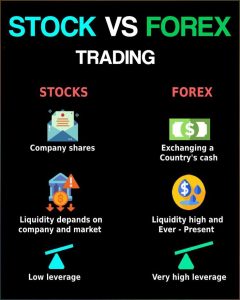
-
High leverage is commonly available, especially to retail traders. In some jurisdictions, leverage can be as high as 1:500.
-
High leverage increases both potential gains and potential losses, making risk management essential.
Stock Market:
-
Leverage is usually lower, often capped at 1:2 for retail traders under regulatory frameworks such as those enforced by the U.S. Securities and Exchange Commission (SEC).
-
Margin accounts allow for leverage but are more tightly controlled.
5. Market Hours
-
Forex is open 24 hours a day, from Sunday evening to Friday evening (UTC), as trading passes through major financial centers in Sydney, Tokyo, London, and New York.
-
Stock markets are open during national business hours and are closed on weekends and public holidays.
6. Influencing Factors
-
Forex is influenced by macroeconomic data like interest rates, inflation, GDP, employment figures, and political stability.
-
Stocks are affected by company earnings, market sentiment, mergers, acquisitions, and analyst reports.
7. Transaction Costs
-
Forex trading typically involves spreads, which are the differences between the bid and ask price. These spreads are usually minimal for major pairs.
-
Stock trading involves broker commissions, exchange fees, and sometimes a spread, depending on the broker and exchange.
Strategic Implications for Traders and Investors
Long-Term vs. Short-Term Trading
-
Forex is ideal for short-term traders, scalpers, and day traders due to its liquidity and volatility.
-
Stocks are often favored by long-term investors focused on value investing, dividend income, and portfolio growth.
Portfolio Diversification
Both markets offer diversification opportunities, but the motivations differ:
-
Forex adds macroeconomic exposure and global risk management.
-
Stocks provide sectoral and corporate growth exposure.
Technology and Platforms
Modern platforms like MetaTrader, cTrader, NinjaTrader, and TradingView support forex trading, while platforms such as E*TRADE, Robinhood, Fidelity, and Charles Schwab cater to stock investors. Many brokerages now offer multi-asset platforms, enabling traders to explore both markets from a single interface.
Conclusion
The foreign exchange market and the stock market are powerful financial tools, each offering unique benefits and risks. While the forex market boasts massive liquidity, global reach, and high leverage, the stock market provides equity ownership, corporate profit-sharing, and long-term growth opportunities.
Understanding the key differences between these markets allows investors to make informed decisions that align with their financial goals, risk tolerance, and investment timelines. Whether you’re a seasoned trader or a novice investor, choosing between forex and stocks—or incorporating both into a diversified strategy—can significantly enhance your wealth-building journey in today’s dynamic financial world.
Why Offline Gambling Still Thrives