
 By admin
The Relationship Between Gold and the U.S. Dollar — And How It Shows Up in Markets
Introduction
The price of gold and the value of the U.S. dollar are two of the most-watched variables in global finance. Investors, central banks, and traders constantly monitor their interplay because it reveals shifting expectations about inflation, real interest rates, monetary policy, geopolitical risk, and liquidity. At first glance the relationship seems simple and well-known: gold and the U.S. dollar tend to move in opposite directions. In practice, however, the connection is more nuanced — sometimes strong and predictable, sometimes weak or even temporarily reversed — and its effects show up clearly across spot markets, futures, exchange-traded funds (ETFs), and equity markets. This article explains the mechanics behind that relationship, why real interest rates and central-bank policy are the dominant drivers, how the link appears in stock markets, and what modern episodes (including the 2020s) teach investors about managing portfolios that include gold and dollar exposures.
1. Basic mechanics: why gold and the dollar are often inversely correlated
1.1 Dollar-denomination and international pricing
Gold is priced in U.S. dollars on global markets. When the dollar strengthens versus other currencies, a given dollar price buys more foreign currency worth of gold — effectively making gold more expensive for non-dollar buyers and often reducing demand; when the dollar weakens, gold becomes cheaper outside the U.S., supporting higher dollar-denominated gold prices. That simple pricing channel explains much of the commonly observed inverse correlation between the two assets. (Investopedia)
1.2 Gold as an alternative “currency” and store of value
Beyond the mechanics of pricing, investors view gold as a kind of non-interest-bearing currency and a long-duration store of value. When confidence in fiat money falls, or when inflation fears rise, gold’s appeal as an alternative increases. Because the U.S. dollar is the dominant global reserve currency, concerns about the dollar’s purchasing power often translate into higher demand for gold. Conversely, when dollar confidence is high and global liquidity favors cash, demand for gold tends to ebb. (Investopedia)
2. Real interest rates: the true common driver
2.1 Opportunity cost of holding gold
A cornerstone of modern understanding is that real (inflation-adjusted) interest rates are the most powerful direct driver of gold’s price. Gold pays no coupon; therefore, when real yields on Treasury and other safe assets rise, the opportunity cost of holding gold increases and its price tends to fall. When real yields decline — especially when they turn negative — gold becomes more attractive as a store of value and as an inflation hedge, even if nominal rates remain positive. Central banks’ rate paths and market expectations for inflation therefore exert an outsized influence on gold. Empirical studies and central-bank research repeatedly confirm this relationship. (Federal Reserve Bank of Chicago)
2.2 How real rates interact with the dollar channel
Real rates affect both gold and the dollar but through different mechanics. Higher U.S. real rates tend to attract global capital into dollar assets, supporting a stronger dollar, while simultaneously making non-yielding gold less attractive. That confluence tightens the negative correlation. However, when real rates fall for reasons that also weaken the dollar (for example, coordinated easing or dollar depreciation driven by fiscal concerns), both gold and weaker dollar can rise together — producing scenarios where both assets strengthen at once. Recent market episodes in the 2020s illustrate both archetypal and exceptional behavior. (Federal Reserve Bank of Chicago)
3. Episodes and anomalies: when the usual pattern breaks
3.1 Simultaneous strength in the dollar and gold
Traditionally inverse, the gold–dollar relationship has sometimes behaved unusually. In certain periods (most notably during parts of 2022–2025), gold set record highs while the dollar remained resilient or even strengthened. Those episodes are explained by overlapping drivers: heightened inflation worries (pushing gold higher), central-bank policy divergence, or safe-haven flows that supported both dollar and gold demand. In short, different risk channels (flight to safety into dollars and demand for inflation protection via gold) can operate at the same time and push both assets up. Market commentators and exchange operators have documented that this “both-up” phenomenon became more visible during recent geopolitical and macro stress events. (cmegroup.com)
3.2 Short-term noise from positioning, liquidity and flow dynamics
Short-term deviations from the historical correlation also arise from technical factors: ETF inflows/outflows, futures-market positioning, options gamma hedging, margin calls, and central-bank gold buying or selling. For example, large ETF purchases increase physical/ETF demand and can lift gold prices even if the dollar is firm. On the futures side, concentrated speculative positions or forced deleveraging can temporarily decouple price movements from fundamentals. This means traders should be cautious extrapolating a short-term move into a lasting regime change. (phillipnova.com.sg)
4. How the gold–dollar link shows up in stock markets
4.1 Gold as a hedge and its behaviour during equity stress
Gold historically acts as a partial hedge against equity market declines. During sudden equity sell-offs or geopolitical shocks, investors often rotate out of risky assets into perceived safe havens — cash (dollars) and gold among them. The relative mix depends on the shock’s nature. A systemic banking scare may favour cash and dollar liquidity, while an inflationary shock or loss of faith in currency might favour gold more strongly. Empirical studies find that gold’s correlation with stocks becomes more negative during crises, enhancing portfolio diversification value. (diva-portal.org)
4.2 Sectoral and cross-asset transmission mechanisms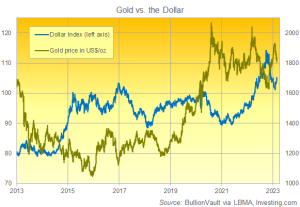
The gold–dollar relationship affects equity sectors unevenly. Commodity-exposed sectors, mining equities, and industrial metals firms often move with the gold price. A rising gold price can buoy mining stocks and related ETFs even while broader indices fall. At the same time, a stronger dollar can hurt multinational exporters and commodity producers reporting in dollars, creating divergence within equity markets. Traders watching cross-asset signals will therefore see clear, contemporaneous moves: rising gold lifts miners; a stronger dollar pressures export-oriented equities and emerging-market stocks. (besra-journals.net)
4.3 Portfolio construction implications for investors and fund managers
For portfolio managers, the gold–dollar dynamic argues for using gold as a tactical and strategic sleeve. Strategically, a modest allocation to gold (physical, bullion ETFs, or mining equities) can reduce long-term portfolio volatility and provide inflation protection when real rates fall. Tactically, managers may overweight gold when inflation expectations rise or when real yields turn negative; they may favour dollar liquidity (short-term T-bills) in episodes of acute market liquidity stress. Importantly, managers should not expect a perfect or constant negative correlation — rather, they should plan for regime changes and cross-asset divergence. (Federal Reserve Bank of Chicago)
5. Practical indicators and metrics to watch
5.1 The U.S. Dollar Index (DXY) and major cross-rates
Tracking DXY provides a direct read on dollar strength versus a basket of major currencies. Sharp moves in DXY often precede or coincide with moves in gold; an appreciating DXY typically pressures dollar-priced gold. But watch for divergence during episodes where both assets rise. (phillipnova.com.sg)
5.2 Real Treasury yields (nominal yields minus inflation expectations)
Real yields — for example, the 10-year Treasury nominal yield minus breakeven inflation from TIPS — often move inversely to gold. Rising real yields suggest stronger returns for bondholders and typically weigh on gold; falling real yields increase gold’s relative appeal. Traders and investors should watch TIPS breakevens and real-yield curves to anticipate gold moves. (Federal Reserve Bank of Chicago)
5.3 Inflation expectations and consumer price readings
Gold often rallies when markets fear persistent inflation. Therefore, core CPI, PCE (personal consumption expenditures), and surveys of inflation expectations are essential inputs. If inflation expectations rise while nominal yields lag, gold tends to benefit. (Financial Times)
5.4 Central-bank actions and reserve managers
Central banks’ purchases or sales of physical gold — and their wording around foreign-exchange intervention — can move markets. Similarly, fiscal announcements that threaten sovereign-creditworthiness can push investors into gold as a store of value. Keep an eye on central-bank minutes, official reserve reports, and large public statements. (cmegroup.com)
6. Trading and investment approaches that use the relationship
6.1 Hedging inflation risk with gold exposures
Long-term investors who fear persistent inflation can allocate to spot gold, gold ETFs, or gold mining equities to hedge purchasing-power risk. The effectiveness depends heavily on the drivers of inflation and expected real rates. A balanced approach is to combine gold with inflation-linked bonds and commodity exposures. (Federal Reserve Bank of Chicago)
6.2 Using dollar positions tactically
Currency overlays — short or long dollar exposures via FX forwards, futures, or currency ETFs — can complement gold holdings. For example, if an investor expects the dollar to weaken (boosting gold via the price channel), a combined long-gold/short-dollar stance may amplify returns (and risks). But careful risk management is essential because both assets can unexpectedly move together. (Investopedia)
6.3 Cross-asset pairs and dispersion trades
Sophisticated traders use cross-asset strategies that pair gold with interest-rate instruments or with dollar-denominated FX pairs (e.g., long gold vs. short DXY futures). These trades rely on mean reversion in the historical relationships but require monitoring of positioning and macro news that can create structural regime changes. (phillipnova.com.sg)
Conclusion: a nuanced, conditional relationship with clear market fingerprints
The gold–U.S. dollar relationship is foundational to modern markets: a structural negative correlation driven by dollar-denominated pricing and investor preferences, and a deeper common dependence on real interest rates and monetary policy. In practice, the connection is conditional. Real yields are the single most important macroeconomic variable for gold, but dollar moves, inflation expectations, geopolitical risk, and liquidity dynamics all shape the day-to-day correlation. On equity markets, the relationship shows up via sectoral dispersion, safe-haven flows, and shifting correlations during crises. For investors and traders the right takeaway is not a fixed rule but a toolbox: monitor DXY, real yields, inflation data, and central-bank signals; use gold as both a strategic diversifier and a tactical hedge; and be prepared for periods when both gold and the dollar rise together — moments that signal overlapping but distinct risk drivers are active at once. (Federal Reserve Bank of Chicago)
Origins and Evolution of Wall Street
Sources & further reading (selected)
- CME Group — commentary on evolving gold–dollar dynamics. (cmegroup.com)
- Chicago Fed — research on gold’s sensitivity to expected long-term real interest rates. (Federal Reserve Bank of Chicago)
- Financial Times — reporting on the 2025 gold rally and dollar movements. (Financial Times)
- Reuters — market coverage linking gold moves to dollar strength episodes. (Reuters)
- Investopedia — primer on why gold often moves opposite to the U.S. dollar. (Investopedia)